The Borderless Story
The City That Shouldn’t Exist
Stand at the centre of Europe Square on a warm spring afternoon and you will see something that would have been unthinkable seventy years ago. Children kick footballs across a mosaic set into the pavement — a circular pattern bearing the numbers “57/15,” transferred from the old border stone that once divided this plaza between two countries, two armies, two worlds.
The Border in Five Minutes
- 1947: The Paris Peace Treaty divides Gorizia. Italy keeps the historic city; Yugoslavia builds Nova Gorica from scratch.
- 1948–1991: The “Gorizia Wall” separates families for nearly six decades. Smuggling becomes survival; coffee functions as border currency.
- 2004: Slovenia joins the EU; the wall is torn down in a public ceremony.
- 2007: Schengen removes all border controls permanently.
- 2025: Nova Gorica and Gorizia become the first joint cross-border European Capital of Culture.
In 1947, diplomats in Paris redrew the border between Italy and Yugoslavia through the heart of a single community. The historic city of Gorizia — with its medieval castle, baroque piazzas, and thousand-year heritage — remained on the Italian side. Yugoslavia received 92% of the surrounding territory yet kept only 26% of the population. Rather than accept the loss, Yugoslavia decided to build an entirely new city from scratch on empty farmland, right against the new border. Its name: Nova Gorica — “New Gorizia.”
The city was entrusted to Edvard Ravnikar, a Slovenian architect who had studied under Jože Plečnik and worked in Le Corbusier’s Paris studio. Ravnikar’s vision drew from the Athens Charter of CIAM: a garden city of rational grids, wide boulevards, and dual-orientation apartments harmonising nature with modern living. Construction began on 13 June 1948 with 25 brigades of nearly 5,200 young people. Then the Tito–Stalin split cut Soviet funding, and by 1951 the original plan was abandoned. Only 11 of Ravnikar’s planned buildings were completed.
Timeline: From Roman Castrum to European Capital of Culture
| Year | Event | Significance |
|---|---|---|
| 50 BC | Roman settlement of Castrum at what becomes Gorizia | Establishes the region as a strategic crossroads of empire |
| 1001 AD | Solkan church founded | Among the oldest Christian sites in the region |
| 1539 | Marian apparition at Sveta Gora | Creates one of Slovenia’s most important pilgrimage destinations |
| 1623 | Kostanjevica Monastery founded by Capuchin monks | Houses Europe’s second-largest Bourbon rose collection |
| 1905–1906 | Solkan Bridge built; Transalpina railway inaugurated | World’s longest stone-arch railway bridge (85 m span) |
| 1915–1917 | Twelve Battles of the Isonzo | Over one million casualties along the future border line |
| 1920 | Treaty of Rapallo establishes Italy–Yugoslavia border | Formalises the division later redrawn through Gorizia |
| 1947 | Paris Peace Treaty; Nova Gorica founded | A completely new city conceived as a “socialist model city” |
| 1948 | Foundation stone laid (13 June); Tito–Stalin split | Construction begins with 5,200 youth brigades; Soviet funding cut |
| 1951 | Ravnikar’s original plan abandoned | Only 11 of planned buildings completed |
Getting There & Getting Around
Nova Gorica sits at a logistical sweet spot where three nations converge. Within one hour lie Trieste, the Julian Alps, the Soča Valley, Vipava wine country, and Gorizia; within two, Ljubljana, Venice, and the Kanin ski slopes. The city functions less as a terminus than as a springboard.
| Mode | Route | Duration | Cost | Best For |
|---|---|---|---|---|
| Air + Bus | Trieste Airport (TRS) | 39 min | EUR 5.60 | Budget, Ryanair routes |
| Air + Shuttle | Ljubljana Airport (LJU) | 2h 45min | EUR 34+ | Long-haul connections |
| Air + Transfer | Venice Marco Polo (VCE) | 1h 30min | EUR 44+ | Wide route network |
| Train | Nova Gorica–Gorizia | 5 min | EUR 1.70 | Cross-border hops |
| Train | Nova Gorica–Venice | 2 hours | EUR 16.10 | Day trips |
| Bus (Free) | Nova Gorica city lines | Varies | Free | Weekday exploration |
| Bus (Cross-border) | Nova Gorica–Gorizia | 10–15 min | EUR 1.70 / EUR 3.40 day | Frequent cross-city travel |
| E-bike Share | GO2GO (both countries) | Flexible | From EUR 6/3hrs | Flexible sightseeing |
| Car | A34 (Italy) / A1 (Ljubljana) | 26 min from TRS | EUR 15–90/day | Wine country, day trips |
| Walk | Nova Gorica–Gorizia | 46 min | Free | The border experience |
The Modernist City — A Self-Guided Walking Tour
Here is the paradox that makes Nova Gorica worth walking: a city built by bureaucrats in a hurry, following utopian blueprints drawn by an architect who had spent a few months in Le Corbusier’s Paris studio, has become — seventy-five years later — a genuinely pleasant place to live. The wide streets catch the morning sun. Lime trees and roses soften the concrete.
Ravnikar vs. Reality
What was planned: A garden city for ~20,000 residents with 12 symmetrical Russian Blocks, a double avenue of plane trees, a Communist Party building, a cultural centre, and a rational grid defining the entire urban fabric.
What was built: 11 buildings — 6 Russian Blocks, 4 Koren stream blocks, and the municipal building. The northern 6 blocks never materialised. The plane trees were never planted. The cultural centre and party building remained on paper.
Route North — Station to Bevkov Square: Start at the Nova Gorica Railway Station (1906). Walk through the 2025 Vrtača Underpass — a 36.6-metre pedestrian link beneath the tracks. Head north along Kidričeva Street to see the Russian Blocks (Kidričeva 29–34, 1948–1950), then continue to Bevkov Square with its bronze model of Ravnikar’s plan.
Route South — Bevkov Square to Kostanjevica: Head south along Ulica Heroja Štuklja, the modernist commercial spine. Look for the Beehive (Čebelnjak, 1962–1963, Ernest Bergant) with its distinctive hexagonal facade. Stop at the Municipal Palace (1949–1953, Vinko Glanz), the Slovenian National Theatre (1987–1994, Vojteh Ravnikar), and the France Bevk Public Library (1996–2000).
Modernist Details Worth Seeking Out
| Building | Architect | Year | Significance |
|---|---|---|---|
| Russian Blocks (6 of 12 planned) | Edvard Ravnikar | 1948–1950 | Finest modernist residential architecture in former Yugoslavia; dual-orientation apartments |
| Municipal Palace (Town Hall) | Vinko Glanz | 1949–1953 | Largest building from early period; stone colonnade, Kalin sculptures, Pengov frescoes |
| Icarus Monument (Edvard Rusjan) | Janez Lenassi | 1960 | First public monument in Nova Gorica; brutalist reinforced concrete |
| Bus Station | Milivoj Lapuh | 1962 | Elegant reinforced concrete with large glass surfaces |
| The Beehive (Čebelnjak) | Ernest Bergant | 1962–1963 | Distinctive hexagonal loggia pattern in red and yellow concrete |
| Cankar Housing Estate | Tomaž Vuga (planner) | From 1968 | Largest neighbourhood; ~2,500 apartments, peak population ~9,000 |
| Slovenian National Theatre | Vojteh Ravnikar | 1987–1994 | Most important postmodernist work in the city; 371-seat main hall |
| France Bevk Public Library | Vojteh Ravnikar, Maruša Zorec, Robert Potokar | 1996–2000 | Sleek concrete with 4,500+ m² of library space |
| Eda Center | DANS (inspired by Ravnikar’s model) | 2011 | Contemporary building referencing heroic-modernist urbanism |
| Vrtača Underpass | Sadar + Vuga, Ana Skobe | 2025 | 36.6 m pedestrian/cyclist link transforming station from barrier to connector |
Europe Square — Walking Across a Border
Stand in the centre of the square and place one foot in Italy, the other in Slovenia. No guard checks your papers. No barrier rises to meet you. The only thing that changes is the texture beneath your soles — from Slovenian paving stones to Italian cobble — and perhaps the language drifting from a nearby table.
This is Trg Evrope to the north and Piazza Transalpina to the south: Europe’s only transnational main square, a public space that belongs to two countries simultaneously. Until 2004, this simple act was impossible. For nearly sixty years, a wall known locally as “the Gorizia Wall” bisected the square. Today, a circular mosaic designed by artist Franko Vecchiet marks the exact border point.
Two Countries, One Square — A Half-Day Route
- 09:00 — Coffee on the Slovenian side; watch commuters through the Vrtača Underpass.
- 09:30 — Cross the Vecchiet mosaic; photograph bilingual signage and the 1906 station façade.
- 10:00 — Walk Corso Verdi to Piazza della Vittoria; visit Sant’Ignazio church.
- 11:00 — Ascend to Gorizia Castle; explore the Great War Museum.
- 12:30 — Visit the Synagogue of Gorizia (Tue/Fri/Sun 10:00–18:00, free).
- 13:30 — Lunch in Gorizia — try frico or Montasio cheese dishes.
- 15:00 — Return across the square to Nova Gorica; allow time for the EPICentre.
The 2025 renovation reduced the station tracks from fourteen to six and created the Vrtača Underpass — up to eight metres wide, naturally lit through a central skylight. From 8 February 2025, direct passenger trains began running between Nova Gorica and Venice Mestre for the first time in the modern era.
Nature & Heritage
The Soča River & Solkan Bridge
There is a moment every traveller to the Soča Valley remembers — the first glimpse of the water. A flash of colour between pine branches, a pool of liquid turquoise in a limestone gorge, so impossibly vivid it looks digitally altered. The Soča River earns its epithet, the “Emerald Beauty,” through Alpine chemistry: microscopic particles of limestone and marl suspended in snowmelt scatter light to reflect the green-blue end of the spectrum.
The colour originates from rock flour — fine-grained particles of limestone bedrock ground by glacial action and suspended in the current. Water temperature stays a bracing 8–12°C year-round, supporting a unique ecosystem that includes the endemic Marble Trout (Salmo marmoratus), found nowhere else on Earth.
Hemingway’s River
Ernest Hemingway never set foot in the Soča Valley, yet his shadow falls across it. His 1929 novel A Farewell to Arms includes the definitive literary rendering of the Caporetto retreat. The Kobarid Museum prominently displays his portrait alongside WWI artefacts, and Walk of Peace materials invoke his name.
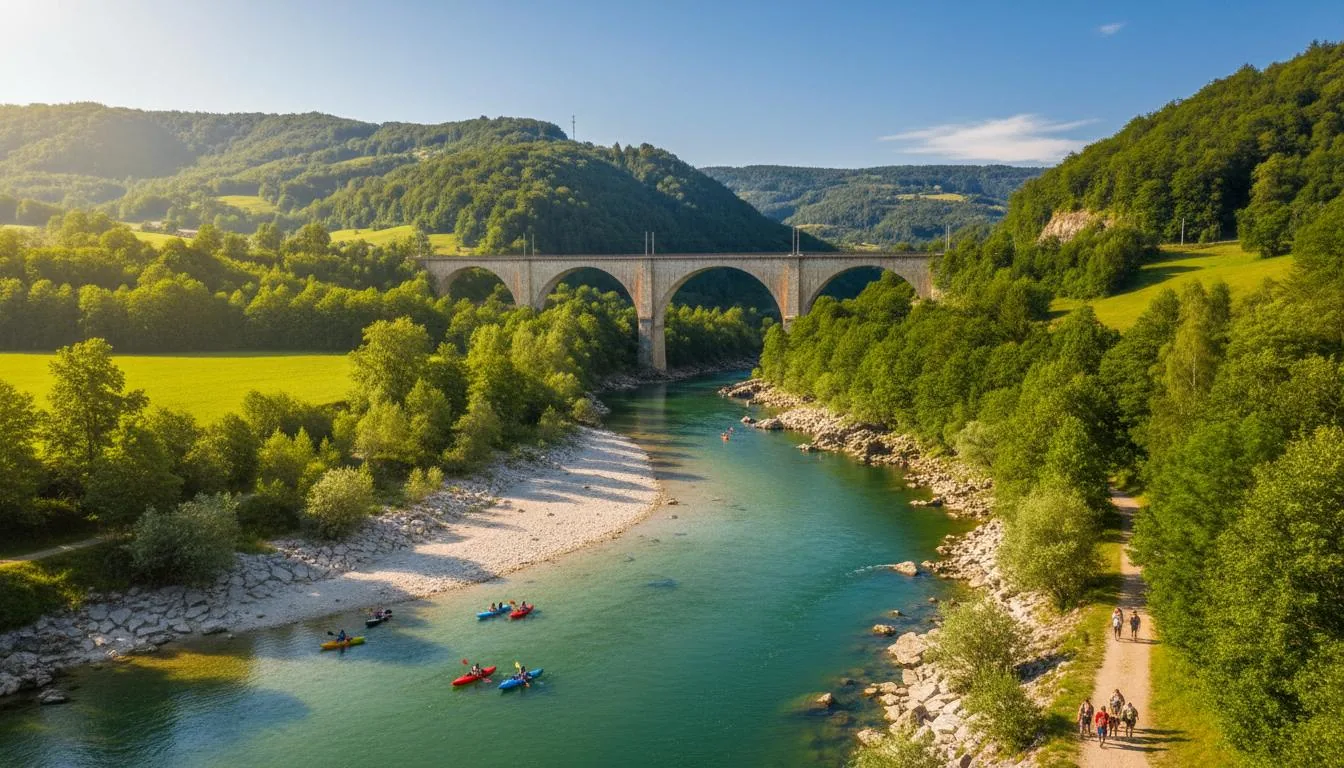
Solkan Bridge: Where the Soča meets the edge of Nova Gorica, it passes beneath a structure that bridges not only the river but centuries of European history. Built between 1904 and 1906, the bridge holds the record as the world’s largest stone-arch railway bridge, with an 85-metre span. The arch was assembled in just 18 working days in June 1905, using 1,941 cubic metres of stone totalling over 5,200 tons. When Austro-Hungarian engineers blew the arch on the night of 8–9 August 1916, the entire Otto Wagner Art Nouveau railing plunged into the river. The stone arch was rebuilt in 1925–1927 and trains still cross daily.
Sabotin Peace Park & WWI Heritage
From the ridgeline of Mount Sabotin, the view is one of almost unbearable serenity. On clear days you can trace the Soča River westward toward the Adriatic, watch hawks ride thermals above the Brda vineyards, and pick out the shimmer of the Friuli plain. But beneath the grass and wild thyme lie trenches where tens of thousands of men fought and died.
When Italy entered the war on 23 May 1915, commander Luigi Cadorna launched a campaign to break onto the Slovenian plateau. Twelve major engagements followed between June 1915 and October 1917 along a 90-kilometre front. Italy suffered approximately 728,754 casualties; Austro-Hungarian fatalities reached approximately 200,000. Combined casualties exceeded one million, making this “the largest battlefield in the alpine area in human history.”
Sabotin was a key Austro-Hungarian defensive point until the Sixth Battle in August 1916, when Italian forces captured the summit. Today, Sabotin Peace Park preserves the network of trenches and caverns as an open-air museum. Entry costs €5 for adults, with guided cavern tours at €7 per person. The centre operates weekends and public holidays, 10:00 to 18:00 in summer and 10:00 to 15:00 in winter.
The Caporetto Breakthrough
The Twelfth Battle of the Isonzo — the Caporetto Retreat to Italians, the Miracle of Kobarid to Austro-Hungarian and Slovenian historians — began on 24 October 1917. A coordinated Austro-Hungarian and German offensive shattered the Italian lines within days. More than half the Italian Army — some 1.5 million men — retreated, joined by over 200,000 civilians. Among the German officers was First Lieutenant Erwin Rommel.
Sveta Gora & Religious Heritage
In a small Franciscan monastery perched above Nova Gorica, six white marble sarcophagi hold the remains of the last Bourbon kings of France. The final resting place of Charles X — the only French king buried outside his homeland — lies a stone’s throw from a city that did not exist when he died in 1836.
Sveta Gora (Holy Mountain): The most important pilgrimage site in western Slovenia traces its origins to a spring morning in 1539, when shepherdess Urška Ferligoj reported a vision of the Virgin Mary. The present Basilica of the Assumption of Mary was built from 1924 to 1928 in Neo-Baroque style after Italian artillery destroyed the original church during the Isonzo Front battles. From the 682-metre summit, the panorama stretches across the Julian Alps to the Adriatic.
Kostanjevica Monastery: Just above the eastern edge of Nova Gorica, this 1623 monastery is known as “Little Saint-Denis.” Its crypt holds six Bourbon sarcophagi, while the Bourbon Rose Garden holds Europe’s second-largest public collection of Bourbon roses — approximately 70 varieties. The Škrabec Library contains more than 11,500 books including 33 incunabula printed before 1500.
For walkers, the Goriški Camino offers an 82-kilometre cross-border pilgrimage route from the UNESCO-listed Basilica of Aquileia to Sveta Gora, marked with the Solomon’s Knot. The Path of Three Sanctuaries links Sveta Gora with Marijino Celje and Castelmonte across the Italian border — a 34-kilometre triangle of Marian devotion.
Wine & Gastronomy
Vipava Valley & Goriška Brda — Wine Country
Stand in a vineyard on the ridge above Medana and look at the rows of vines. One side drains into Slovenia; the other, identical in soil, slope, and grape variety, drains into Italy. The border here does not follow a river or mountain — it follows a line drawn in 1947 by diplomats who had never set foot in these vineyards. This is, quite possibly, the world’s most absurd wine border — and its most fascinating.
The Bora Wind
The burja is a cold, dry, katabatic wind funnelling through the Vipava Valley from the northeast, recorded at over 200 km/h during winter storms. For viticulture, it is a blessing in violent disguise. Its extreme dryness prevents fungal diseases, rendering many vineyards virtually spray-free. It also acts as a natural selector: only grapes with thick skins survive, yielding lower quantities but more concentrated flavours.
Vipava Valley: Slovenia’s largest PDO wine district at 2,566 hectares produces distinctive wines from indigenous varieties found nowhere else on Earth. Zelen leads the indigenous charge, grown on approximately 85–90 hectares and nearly extinct after WWII before the Zelen Consortium revived it. Pinela was documented in Venetian records as early as 1324. Other varieties include Klarnica, Pergolin, Pikolit, Poljšakica, Vitovska Grganja, and Glera.
Goriška Brda: Often called “the Tuscany of Slovenia,” Brda produces world-renowned Rebula from 1,824 hectares of flysch soils known locally as opoka. The fortified medieval village of Šmartno houses artists’ studios and the Tourist Information Centre. Beneath nearby Dobrovo Castle lies Klet Brda, Slovenia’s largest wine cellar, owned by 400–540 grower families and producing approximately 8 million litres annually.
Recommended Cellars: Where to Taste
| Cellar | Location | Speciality | How to Book |
|---|---|---|---|
| Guerila Wines | Planina, Vipava Valley | Biodynamic; Zelen, Pinela, orange wines | EUR 20–40 tastings via tourist portal |
| Batič Winery | Šempas, Vipava Valley | Founded 1592; Demeter; Zaria amber wine | By appointment |
| Burja Estate | Vipava Valley | Demeter biodynamic; natural wines; family since 1499 | Via website or Raisin app |
| Movia | Medana, Goriška Brda | “Lunar” skin-contact Rebula; 8th-generation | Direct booking |
| Klet Brda | Dobrovo, Goriška Brda | Slovenia's largest cellar; 400 families | Walk-in or pre-booked tours |
| Edi Simčič | Dobrovo, Goriška Brda | Father-son; Classic EUR 35, Premium EUR 55 | Direct booking |
| Tilia Estate | Goriška Brda/Vipava | “The Pinot House”; Pinot Noir specialist | Tourism portal |
| Sutor Winery | Podraga, Vipava Valley | Family since 1933; 5.5 ha; ~15,000 bottles | Direct contact |
| Ščurek Estate | Goriška Brda | 17 ha; BIG SEE Architecture Award guesthouse | Direct booking |
| Enoteca Vipava | Vipava town | 170+ valley wines; no appointment needed | Walk-in |
Where to Eat, Drink & Stay
The Nova Gorica region punches far above its weight in Michelin recognition. Three of the most significant restaurants are within easy reach of the city.
DAM Boutique Hotel & Restaurant holds one Michelin star under Chef Uroš Fakuč and focuses on Mediterranean seafood cuisine. Gostilna pri Lojzetu at 17th-century Zemono Manor holds one Michelin star, 17.5 Gault & Millau points, and serves tasting menus from EUR 80 to EUR 160 with wine pairing. Hiša Franko, led by Chef Ana Roš, holds three Michelin stars and ranked #21 on The World’s 50 Best Restaurants 2025 list.
Beyond the starred kitchens, everyday Goriška cuisine tells its own borderless story: jota (bean-and-sauerkraut soup), frtalja (wild herb omelette), štruklji (rolled dumplings), Tolminc cheese, and Kraški pršut — PGI-protected air-dried ham cured by the Bora wind.
Restaurant Recommendations
| Restaurant | Category | Price Range | Specialty | Location |
|---|---|---|---|---|
| Hiša Franko | Fine Dining (3 Michelin stars) | EUR 350+ | Tasting menu, alpine-Mediterranean fusion | Kobarid, 30 min drive |
| Gostilna pri Lojzetu | Fine Dining (1 Michelin star) | EUR 80–160 | Slow food, 700+ wine labels, Vipava terroir | Zemono Manor, Vipava Valley |
| DAM Boutique Hotel | Fine Dining (1 Michelin star) | EUR 100+ | Mediterranean seafood, chef-guided tasting | Nova Gorica centre |
| Calypso at Perla | Mid-Range (Michelin Selected) | EUR 25–45 | Slovenian-Karst cuisine, casino setting | Nova Gorica |
| Tiffany at Casino Park | Mid-Range | EUR 20–40 | Seafood, 2 Gault & Millau toques | Nova Gorica |
| Vipava Valley Osmica | Budget-Traditional | EUR 15–25 | Farm wine, pršut, sausage, rustic setting | Vipava Valley villages |
| Local burek & pizzerias | Budget | EUR 4–12 | Wood-fired pizza, burek pastries | Both sides of the border |
| Oceanis at Perla | Budget Buffet | EUR 12–18 | All-you-can-eat salads, pasta, hot dishes | Nova Gorica |
Accommodation Options
| Property | Type | Price/Night | Best For | Key Feature |
|---|---|---|---|---|
| Hotel Perla | 4-star Casino Resort | EUR 167–244 | Luxury, casino, spa | 249 rooms, Spa Perla (1,000+ m²), Michelin-Selected Calypso |
| Hotel Park | 4-star Boutique Hotel | EUR 90–148 | Mid-range, quieter alternative | 40-year heritage, free breakfast, Tiffany Restaurant (2 Gault & Millau toques) |
| Hotel Sabotin | 3-star Sports Hotel | EUR 85–108 | Cyclists, outdoor enthusiasts | 8.8/10 rating, bike storage & rentals, Green Key certified |
| B&Bs & Guesthouses | Various | EUR 74–150 | Character, local hospitality | 123+ options in the area, from €74/night |
| Hostel Nova Gorica | Hostel | EUR 27–36/person | Budget travellers | Free gym, parking, Wi-Fi; shared rooms |
| Vineyard Agritourism | Farm Stays | EUR 60–120 | Wine immersion, romance | Estate wines, home-cooked meals, Brda & Vipava Valley settings |
Adventure & Culture
Outdoor Adventures — From the River to the Sky
The Soča River is not merely beautiful — it is a playground. Where other alpine rivers run gray with glacial silt, the Soča runs an impossible emerald, a colour so vivid it seems lit from within. From the first rapid to the last canyon pool, the river and the mountains around Nova Gorica form an adventure corridor that rivals any in the Alps.
Whitewater rafting: The Soča is Slovenia’s premier rafting destination. The lower stretch from Čezsoča to Srpenica (Class I–II) is ideal for families. The middle Boka–Trnovo section (Class II–III) offers dynamic rapids. More than five established operators run daily departures from Bovec between March and October, with prices from €47 to €90 per person.
Canyoning: Sušec Canyon is the valley’s most accessible descent, suitable for families with children from age eight (€67–72). Fratarica Canyon is a significant step up, featuring the celebrated 47-metre Parabola waterfall and rappels up to 48 metres (€98, minimum age 16).
Aerial pursuits: The Učja Canyon Zipline claims the title of Europe’s largest zipline park, with ten steel cables totalling 4.5 kilometres and speeds up to 60 km/h. For a shorter alternative, the Solkan Zipline launches a 550-metre ride directly above the Soča River. Paragliding tandem flights in the Vipava Valley run €150–188 year-round.
Activity Price Guide
| Activity | Intensity | Season | Duration | Cost |
|---|---|---|---|---|
| Whitewater rafting (classic) | Moderate | Mar–Oct | 1.5–2.5 hrs | €47–€90 |
| Whitewater rafting (long) | Moderate | Apr–Oct | 2.5–3.5 hrs | €90 |
| Kayaking (beginner SOT) | Moderate | Apr–Oct | 2–3 hrs | €65–€70 |
| Kayaking (private guided) | Moderate | Apr–Oct | 2 hrs | €70–€85 |
| Canyoning — Sušec | Low–Moderate | Apr–Sep | 2–3 hrs total | €67–€72 |
| Canyoning — Fratarica | High | Apr–Sep | 4–5 hrs total | €98 |
| Zipline Učja Canyon | Moderate–High | Year-round | 2–2.5 hrs | €60–€85 |
| Paragliding tandem | Moderate | Year-round | 2 hrs total | €150–€188 |
| Fly-fishing (guided day) | Low | Apr–Oct | Full day | €250–€450 |
| Fly-fishing (permit only) | Low | Apr–Oct | Full day | €30–€110 |
| Sabotin hiking ridge | Moderate | Year-round | 3–5 hrs | Free (€5 museum) |
| Brda cycling (e-bike) | Low–Moderate | Year-round | 2–6 hrs | €25–€40 rental |
Culture, Casinos & Nightlife
By day, Nova Gorica is a quiet modernist city of wide avenues and rose gardens. After sunset, it reveals a double identity. The glass facade of Casino Perla lights up, drawing Italian-registered cars to its garage. Two hundred metres away, the EPICentre opens for a documentary screening, while a queue forms at Mostovna for a drum’n’bass night.
ECoC 2025 legacy: EPICentre is the €6.38 million flagship with 2,340 m² of exhibition space and the permanent exhibition “City on the Border.” The Nova Gorica City Gallery opened Slovenia’s first tactile gallery in March 2025. SNG Nova Gorica — the Slovene National Theatre — hosts approximately eight premieres per season, and a new 500-seat outdoor amphitheatre opened in 2025.
Festivals: The R.o.R Festival drew over 18,000 visitors in 2023 with light installations across the city. Pixxelpoint is a prominent intermedia art platform. SAXGO is the longest-running music festival. October Jazz and Flores Musicae round out an exceptionally dense cultural calendar for a city of ~13,500 residents.
Casinos: Casino Perla remains the centrepiece with 760 slot machines, electronic roulettes, and traditional table games. Its 650-square-metre poker room has hosted the Italian Poker Tour and Slovenian Poker Tour. Casino Park offers a boutique alternative with 410 slot machines and 18 gaming tables on the site of the original 1984 casino.
The Casino-to-Culture Transition
Nova Gorica is navigating an unusual urban reinvention: a city built on casino tourism is now investing in the opposite identity. While casino revenue faced structural decline, cultural infrastructure expanded: the EPICentre, Slovenia’s first tactile gallery, a new amphitheatre, and free festivals drawing 18,000+ visitors.
Day Trips Beyond the Borderlands
From a single sunrise in Nova Gorica, the day unfolds in four directions at once. Within one hour by public transport: Trieste, Ljubljana, the Soča Valley, or Kobarid. Within ninety minutes by car: Roman mosaics in Aquileia, rafting on the Soča, a star fortress in Palmanova, or a Lipizzaner stud farm.
North: Kobarid Museum (European Museum of the Year 1993) documents the twelve battles of the Soča Front. Tolmin Gorge forms the lowest entry point into Triglav National Park. Bovec is Slovenia’s outdoor adventure capital. Mangart Saddle offers Slovenia’s highest road.
West: Trieste is 44 minutes by train (EUR 6). Piazza Unità d’Italia is Europe’s largest sea-facing square; Miramare Castle sits 8 km northwest. Piran delivers Venetian intimacy on Slovenia’s coast. Škocjan Caves contain one of the world’s largest known underground river canyons.
East: Ljubljana’s compact old town is perfect for a day on foot. Postojna Cave includes the world’s first underground railway. Predjama Castle is built into a 123-metre cliff and holds a Guinness World Record. Lipica has bred Lipizzaner horses since 1580.
South: Cividale del Friuli is a UNESCO town founded by Julius Caesar. Palmanova is a perfect nine-pointed star fortress built by Venice in 1593. Aquileia contains the largest Roman mosaic floor in Western Christendom. Udine offers Venetian piazzas and Tiepolo frescoes.
Day-Trip Destinations Compared
| Destination | Direction | Distance | Transport Time | Ideal Season | Highlight |
|---|---|---|---|---|---|
| Kobarid | North | ~35 km | 35–45 min (car/bus) | Apr–Oct | Kobarid Museum + Kozjak Waterfall |
| Tolmin Gorge | North | ~25 km | 35 min (car) | Apr–Oct | Confluence of two rivers in Triglav NP |
| Bovec | North | ~43 km | 1h 15m (car) | May–Sep | Rafting, zipline, alpine gateway |
| Trieste | West | ~36 km | 44 min (train, €6) | Year-round | Piazza Unità + Miramare Castle |
| Piran | West | ~106 km | 1h 20m (car) | May–Sep | Venetian old town + city walls |
| Škocjan Caves | West | ~61 km | 1h (car) | Year-round | UNESCO underground canyon |
| Ljubljana | East | ~107 km | 1h 15m (bus/car) | Year-round | Pedestrian old town + castle |
| Postojna Cave | East | ~50 km | 1h 15m (car) | Year-round | World's first underground railway |
| Predjama Castle | East | ~50 km | 1h 15m (car) | Year-round | Largest cave castle (Guinness) |
| Lipica | East | ~50 km | 45 min (car) | Year-round | Original Lipizzaner stud farm |
| Cividale del Friuli | South | ~40 km | 30–40 min (car) | Year-round | UNESCO Lombard heritage |
| Palmanova | South | ~45 km | 30–40 min (car) | Year-round | Nine-pointed star fortress |
| Aquileia | South | ~60 km | 45–60 min (car) | Year-round | Largest Roman mosaic floor in the West |
| Udine | South | ~55 km | 55 min (train) | Year-round | Venetian piazzas + Friulian cuisine |
Plan Your Visit
Practical Information
Do you need a passport to walk across Europe Square? No. The Italy–Slovenia border at Nova Gorica has been invisible since 21 December 2007, when both countries implemented the Schengen Agreement and dismantled all routine border controls. You can step from Slovenia into Italy and back again without showing identification to any official — though carrying a passport or national ID card remains a legal requirement, and occasional spot checks do happen.
When to visit: The optimal window runs from mid-April to mid-June, when daytime temperatures settle between 17°C and 26°C, wildflowers carpet the Vipava Valley hillsides, and summer crowds have not yet arrived. September matches this appeal: the mercury hovers around 23°C, the grape harvest is underway, and cultural events spill across both sides. Summer brings peak heat and peak tourist traffic. October is the wettest month. Winter is crowd-free and ideal for casinos, museums, and thermal spas.
Money and phones: Both countries use the euro, so no exchange is needed. EU roaming applies across both countries. The practical complication is network switching: your mobile may latch onto an Italian tower while you are still on the Slovenian side of Europe Square. Manually select your home network if this becomes annoying.
Safety: Slovenia ranks 9th on the Global Peace Index 2025, between Denmark and Finland. Violent crime is extremely rare, and petty theft occurs at rates far below major European tourist cities. Emergency number 112 works in both Slovenia and Italy.
Emergency number
112 (ambulance, police, fire — free, both countries)
Currency
Euro (€) — no exchange needed at the border
Time zone
CET (UTC+1); CEST (UTC+2) March–October
Electrical plug
Type C / Type F (Schuko); 230V, 50Hz
Tipping
Round up in Slovenia; coperto often included in Italy
Tourist tax
€2.50 per person per night (all accommodation)
Language
Slovene (official); Italian widely spoken; English ~74% proficiency
WiFi
Free and widely available in hotels, cafés, and public spaces
Drinking water
Safe everywhere
Global Peace Index
9th safest country worldwide (2025)
Border crossing
Schengen — no routine controls since 2007
EHIC/GHIC
Accepted for EU/EEA/Swiss citizens
Budget Planning
| Category | Backpacker (€50–62/day) | Mid-Range (€87–120/day) | Luxury (€183–310/day) |
|---|---|---|---|
| Accommodation | Hostel dorm €16–22 | B&B or 3-star hotel €35–70 | Hotel Perla/Park €150–250 |
| Food | Groceries + street food €15–20 | Restaurant meals €25–35 | Fine dining €50–80 |
| Transport | Free city bus + walking €0–5 | Cross-border bus + taxi €5–10 | Car rental + transfers €30–50 |
| Activities | Free hiking, museums €0–10 | Wine tastings, entries €15–25 | Spa, casino, guided tours €50–100 |
Suggested Itineraries
The Nova Gorica region presents a traveller’s dilemma of the best kind: too much to see, too many layers to unpack. These four itineraries are starting points, each a different answer to the question “What is Nova Gorica for?”
The Borderlands Taster
A surprising stopover: modernist Nova Gorica, cross Europe Square, and an afternoon in Gorizia.
- 1Morning: Russian Blocks, Icarus Monument, Municipal Palace, Europe Square mosaic
- 2Afternoon: Gorizia Castle, Great War Museum, Sant'Ignazio church
- 3Evening: Cross-border dinner or aperitivo in Gorizia
Frequently Asked Questions
Do I need a passport to walk across Europe Square?
No routine checks — the Italy–Slovenia border at Nova Gorica has been Schengen since 2007. You still need to carry photo ID, and occasional spot checks occur.
What is the best time of year to visit Nova Gorica?
Mid-April to mid-June and September are ideal: mild weather, fewer crowds, and wine harvest or wildflower season. July–August is best for river activities.
How do I get from Trieste Airport to Nova Gorica?
The G1T cross-border bus runs directly from Trieste Airport (TRS) to Nova Gorica station and bus terminal in about 39 minutes for EUR 5.60.
Can I visit both Nova Gorica and Gorizia in one day?
Yes. The two centres are only 3.3 km apart — a 46-minute walk across Europe Square, or a 5-minute train ride for EUR 1.70.
What makes Nova Gorica different from other European cities?
It is the only completely new city built in Europe as deliberate geopolitical compensation after a border was redrawn through an existing community.
Are the casinos worth visiting even if I don't gamble?
Yes. Casino Perla and Park have spas, restaurants, and entertainment. Calypso at Perla is Michelin-Selected and offers excellent value.