A Spiritual Sanctuary on the Border
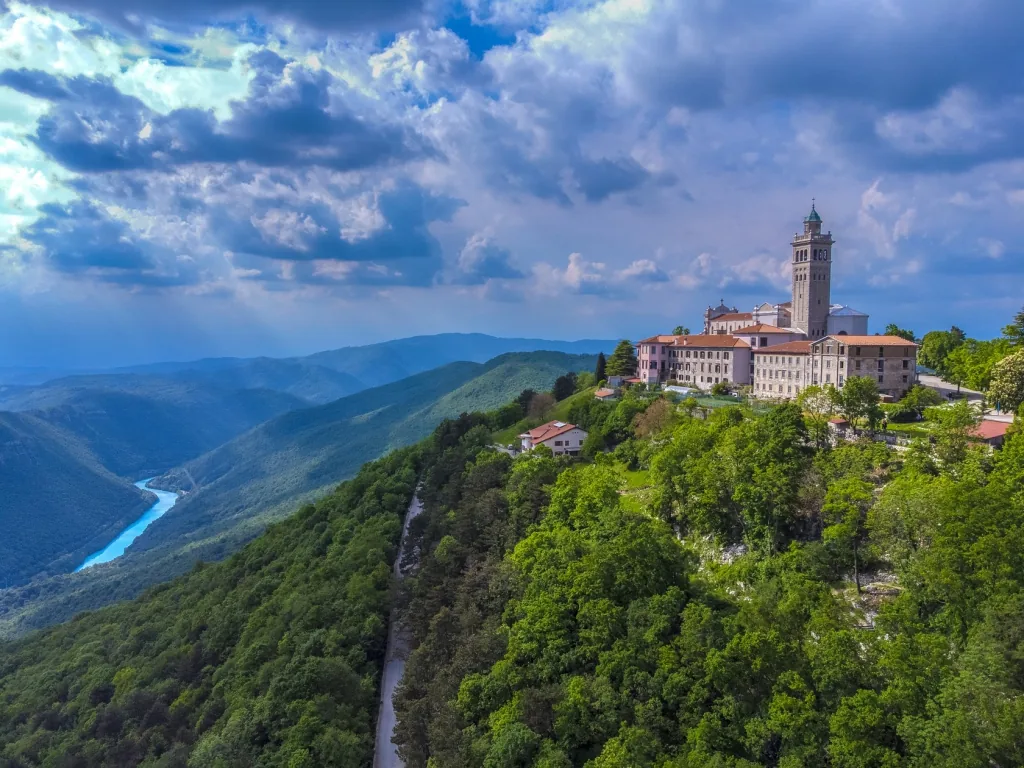
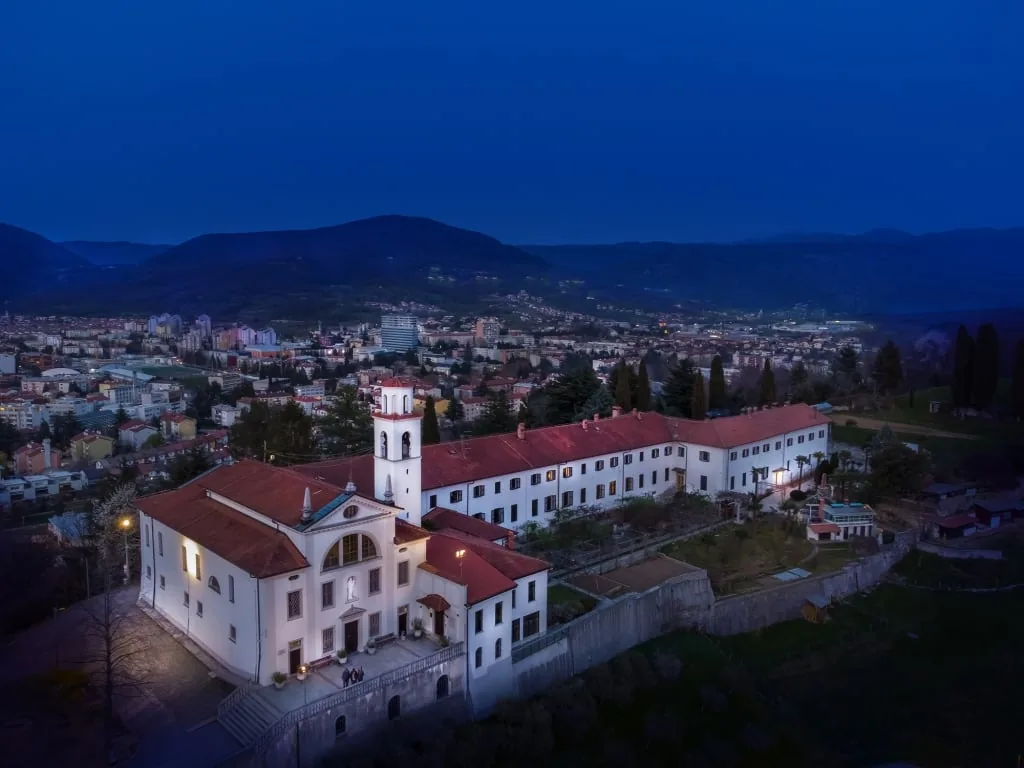
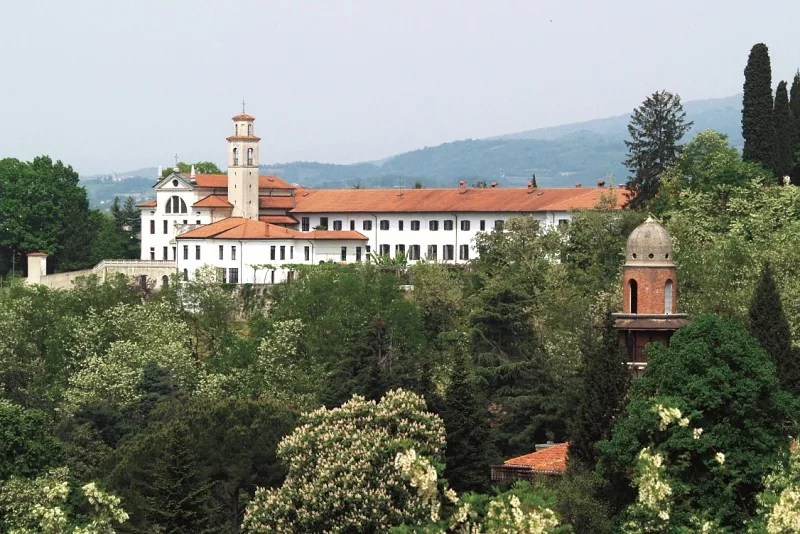
The Kostanjevica Monastery with its Annunciation Church stands majestically on a 143-metre (469-foot) tall hill that divides the town of Nova Gorica from the settlement of Pristava. This sacred site holds a unique position both geographically and historically, located just 200 metres (660 feet) from the Italy-Slovenia border. The monastery has served as a spiritual beacon for centuries, witnessing the changing political landscapes while maintaining its religious significance.
Today, it is recognised internationally as the burial place of Charles X of France and his family, making it a site of particular interest to historians and royalty enthusiasts. Its elevated position offers panoramic views of the surrounding region — from the Italian Veneto delta and the sea on one side, to the Slovenian Vipava Valley and the Julian Alps on the other — creating a peaceful atmosphere that invites contemplation and prayer.
In September 2024, the Government of Slovenia declared the Franciscan Monastery of Kostanjevica a monument of national importance, confirming the exceptional cultural-spiritual value of this sanctuary. This designation followed years of careful restoration work that has revealed hidden artistic treasures beneath centuries of history.
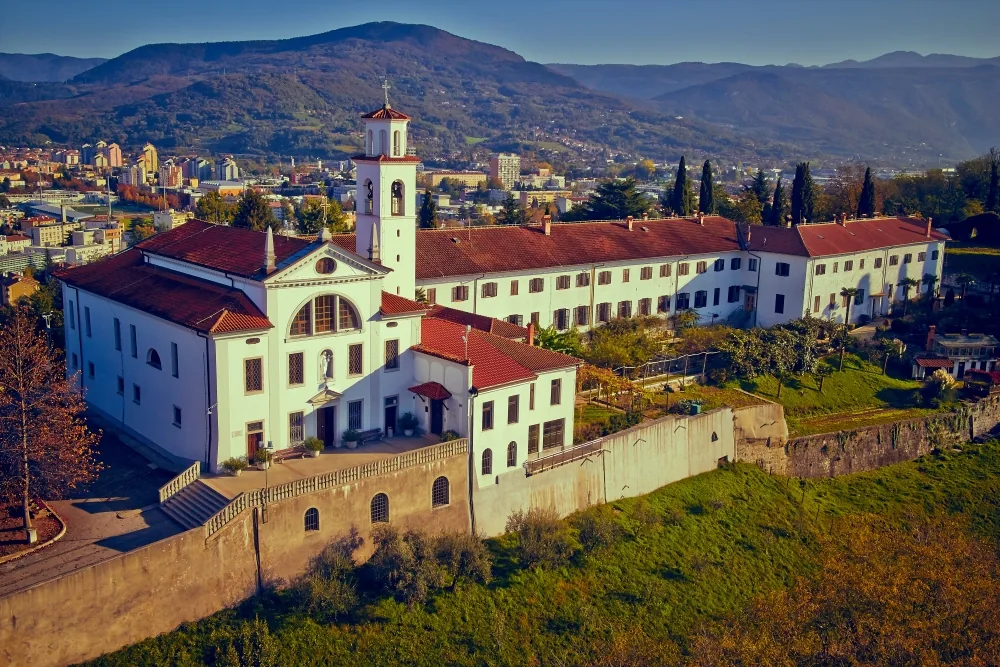
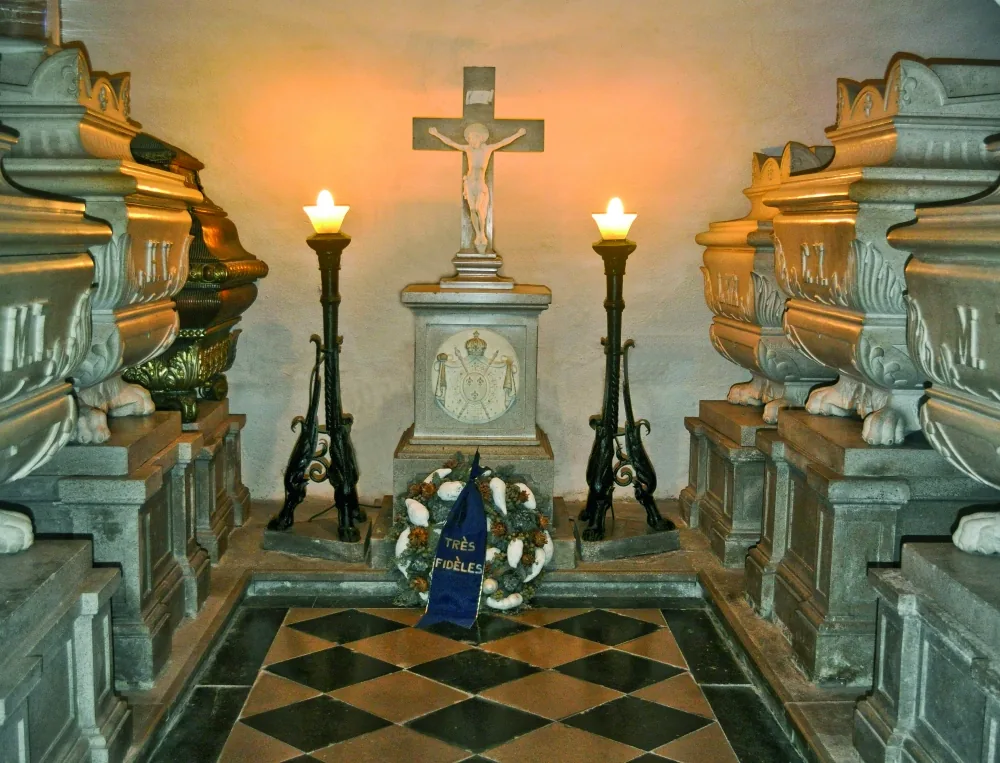
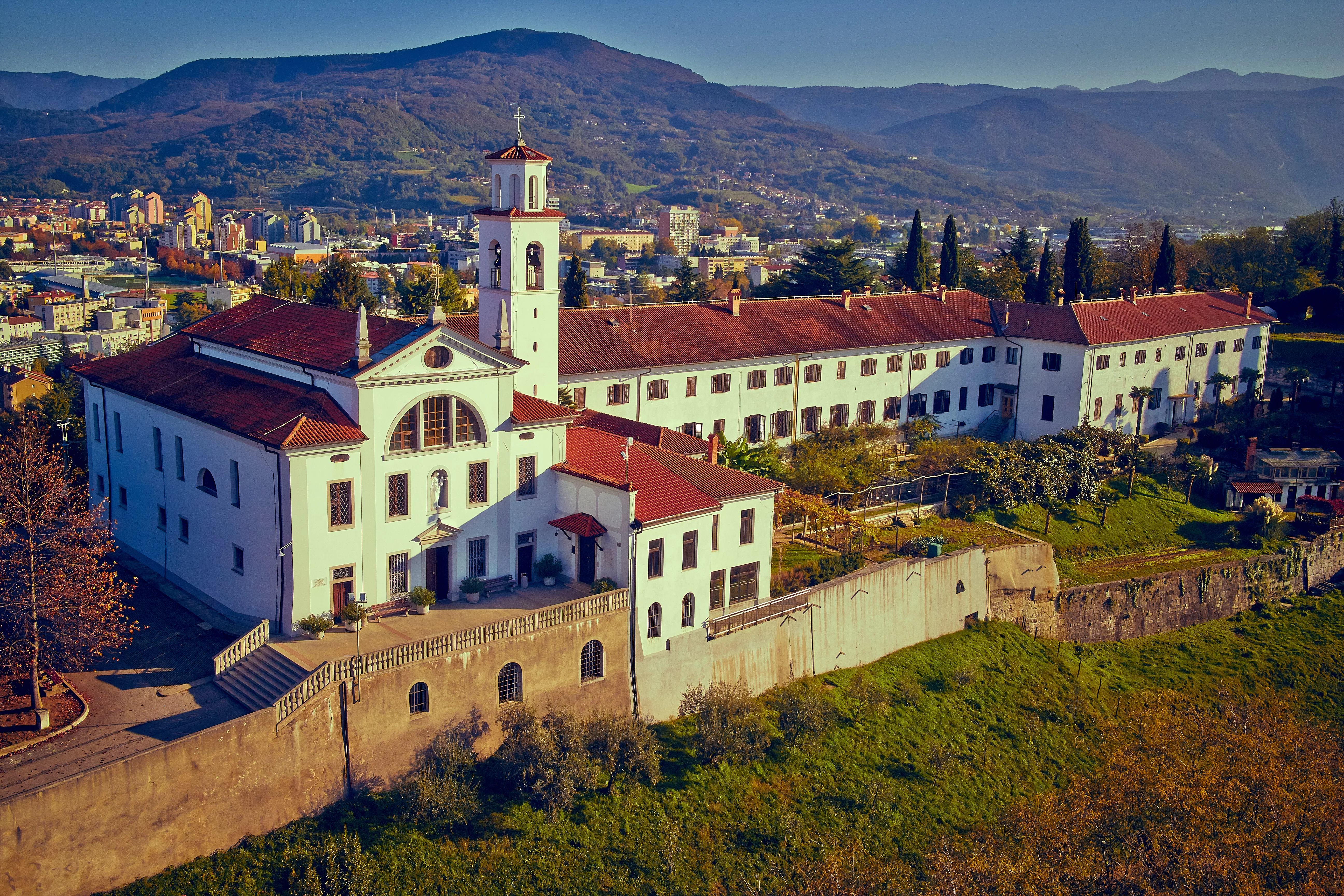
The ornate interior of the Annunciation Church and evening views of the monastery complex overlooking Nova Gorica.
Four Centuries of Spiritual Service
The story of Kostanjevica Monastery is deeply intertwined with the broader history of the Gorizia region, reflecting the religious, political, and cultural currents that have shaped this borderland over 400 years.
Count Matija (Mathias) Thurn commissions a small Carmelite sanctuary on the hill overlooking Gorizia. According to legend, he built it in gratitude to the Pope, who allowed him to marry his cousin. An image of Mary was placed in the modest chapel, and due to its small size, locals still call the site "Kapela" (Chapel) today.
Count Thurn bestows the church and monastery to the Carmelite monks, who begin extensive additions and beautification over the following century. The monastic chapel becomes an important pilgrimage site drawing faithful from Friuli and the Gorizia region.
Emperor Joseph II disbands the monastery as part of his sweeping ecclesiastical reforms. The Carmelites are expelled and the church is closed, remaining abandoned for nearly a decade.
The church is reopened under the priest Filip Poli, bringing renewed spiritual life to the hill.
Franciscan friars from Gorizia acquire the abandoned complex, re-establishing the monastery. They bring a notable library containing approximately 10,000 books transferred from the nearby Sveta Gora Monastery. A philosophical school (monastic gymnasium) is established in 1821.
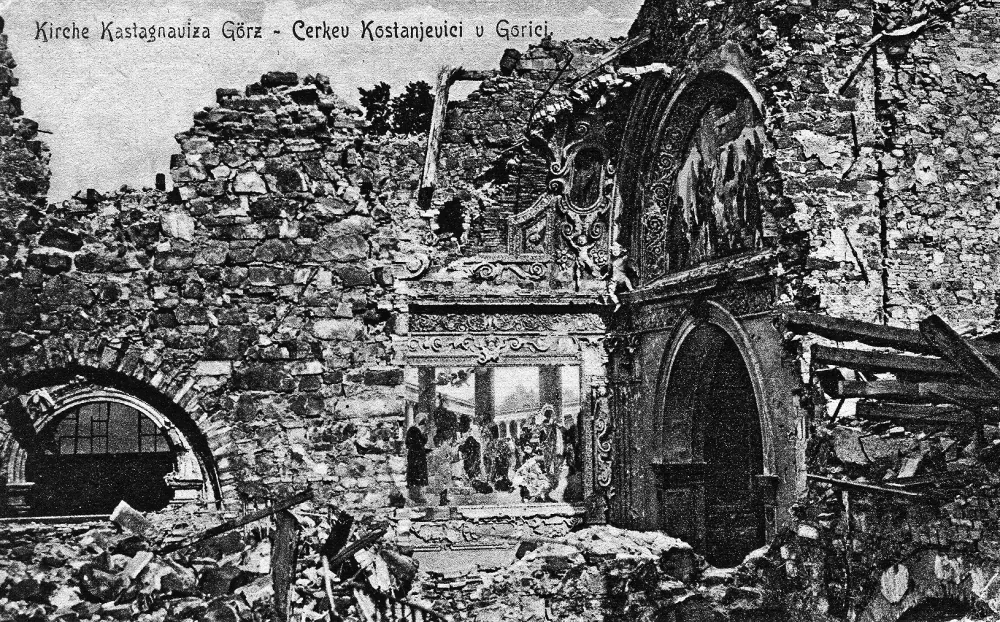
The monastery suffers severe damage during the Battles of the Isonzo in World War I. Much of the valuable art collection is lost, and only a few precious paintings are saved. An inscription by a soldier who spent the night in the church in 1916 was discovered during recent restoration work.
The church is painstakingly restored under Italian Franciscans after Slovene friars had been expelled. The restoration returns the complex to its former glory.
The border between Italy and Yugoslavia is established just a few hundred metres west of the monastery. Kostanjevica becomes part of the newly established town of Nova Gorica. On 14 September 1947, many Slovenians come to bid farewell to Kostanjevica before the demarcation line separates them from the beloved sanctuary.
The Parish of Nova Gorica – Kapela is established, marking the beginning of independent parish life at Kostanjevica.
Part of the monastery is transformed into the Community Srečanje, a rehabilitation centre for young men overcoming drug addiction, based on the programme of Italian priest Pierino Gelmini.
The former monastery garden features a new highlight: the Bourbon rose collection, now one of the most comprehensive and largest in the world.
Extensive restoration of the church's frescoes, stucco decorations, and architectural features. Restorers discover up to seven layers of paintings, uncovering frescoes of the Heart of Jesus and the Heart of Mary hidden for centuries.
The church and monastery are declared a cultural monument of national importance by the Slovenian government.
The Bourbon Crypt — "Little Saint-Denis"
Perhaps the most fascinating aspect of Kostanjevica Monastery is its crypt, which serves as the burial place for members of the French House of Bourbon who went into exile following the July Revolution of 1830. These nobles first found refuge in Edinburgh, Scotland, then in Prague, and finally came to Gorizia where they were received as guests of Count Coronini. When they died, they were buried here, and for this reason Kostanjevica is known as the "Little Saint-Denis" — after the Basilica of Saint-Denis in Paris, the traditional burial place of French kings.
Charles X (1757–1836), the last French king of the Bourbon dynasty, ruled France and Navarre from 1824 to 1830. He was an autocratic ruler whose actions brought about the July Revolution of 1830, forcing the entire family to flee the country. The younger brother of the beheaded King Louis XVI and King Louis XVIII, Charles X died of cholera on 6 November 1836 in the Coronini Palace in Gorizia — just seventeen days after his arrival. On 11 November, he was buried in the church of Kostanjevica. He is the only French king buried outside of France and the only monarch interred in what is now Slovenia.
There are six sarcophagi in the church crypt. The last entombment took place in 1886. In a niche in front of the crypt are the remains of Louis Jean Casimir, Duke of Blacas, Marquis d'Aulps (1771–1839), the Court Minister of Charles X who faithfully accompanied him into exile.
Those Buried in the Crypt
| Name | Title / Relationship | Lifespan |
|---|---|---|
| Charles X | King of France (1824–1830), younger brother of Louis XVI and Louis XVIII | 1757–1836 |
| Louis Antoine | Duke of Angoulême, eldest son of Charles X, pretender as Louis XIX | 1775–1844 |
| Marie Thérèse Charlotte | Duchess of Angoulême, daughter of Louis XVI and Marie Antoinette, wife of Louis Antoine | 1778–1851 |
| Henri | Count of Chambord, grandson of Charles X, pretender as Henry V | 1820–1883 |
| Maria Theresa of Austria-Este | Wife of Henri, Count of Chambord | 1817–1886 |
| Louise Marie Thérèse | Duchess of Parma, sister of Henri V, regent for her son | 1819–1864 |
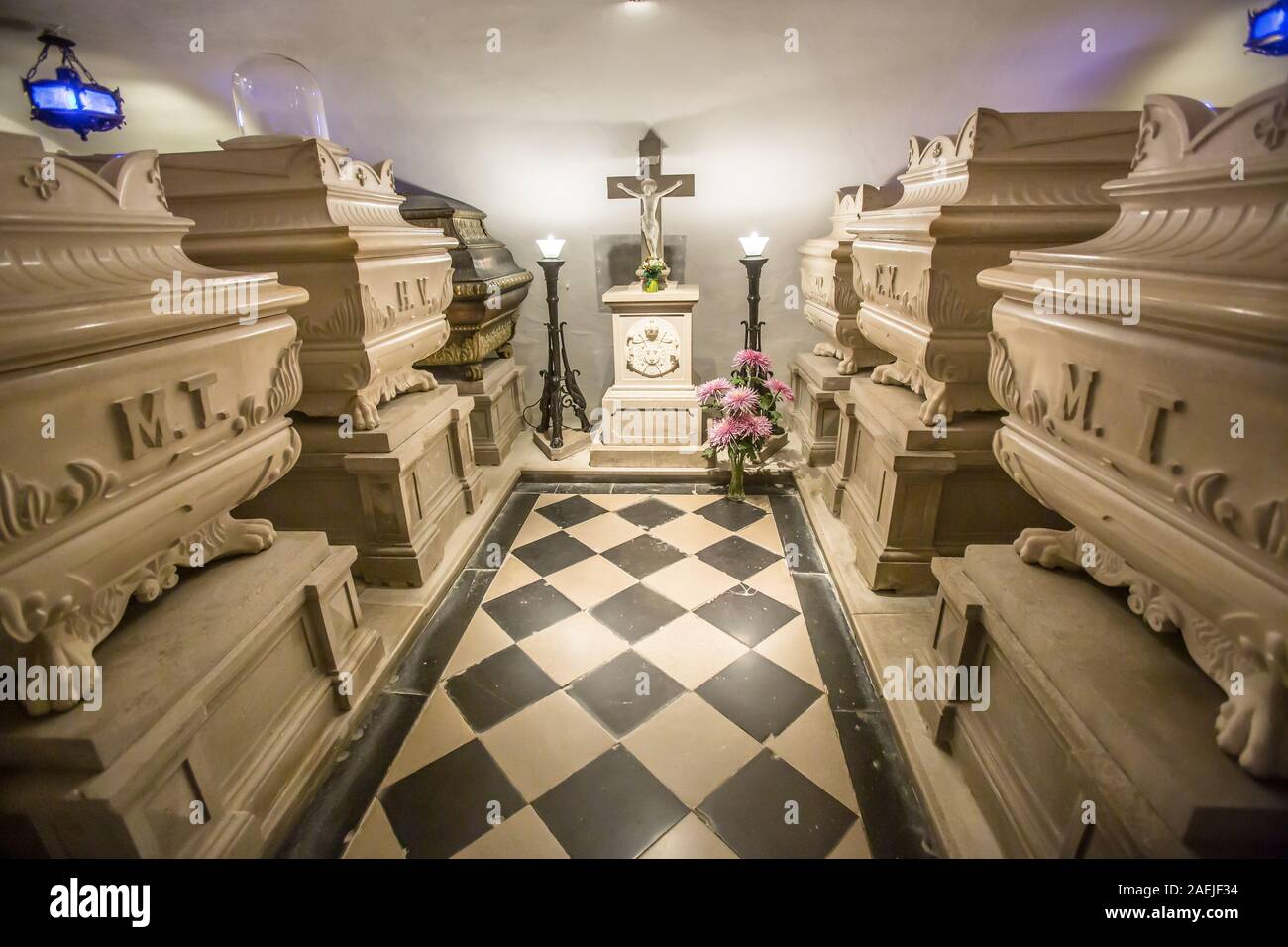
The complete view of the Bourbon crypt with stone sarcophagi arranged on both sides of the central aisle, marked with the initials of each royal personage.
The Škrabec Library — A Scholarly Treasure
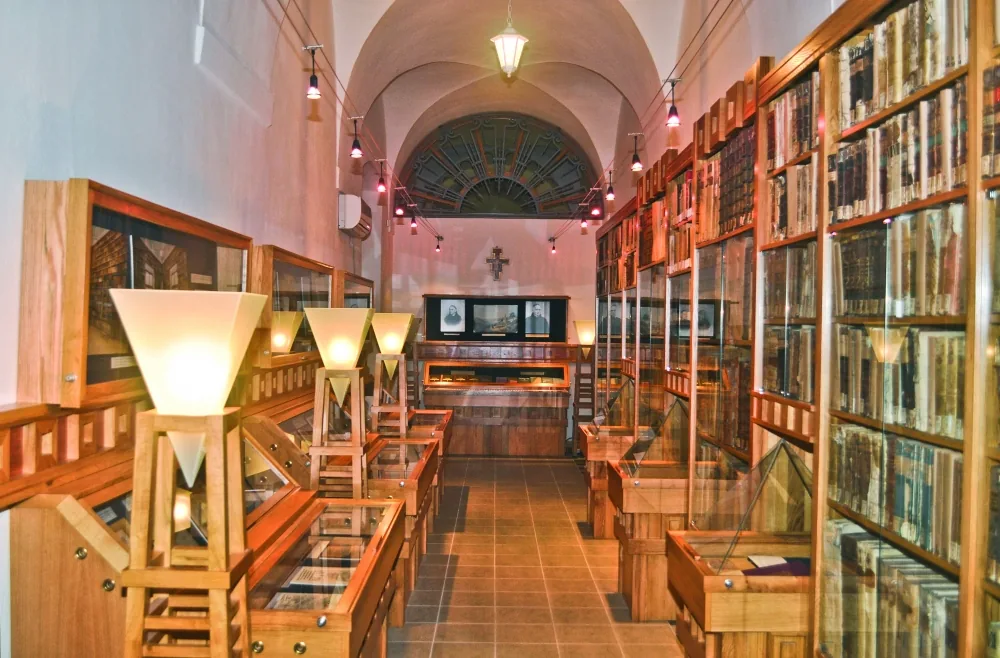
The library at Kostanjevica Monastery stands as one of its most significant cultural treasures. The beginnings of the collection go back to the 16th century with the rich collection from the monastery of Sveta Gora. When the Franciscans had to leave Sveta Gora, they took the library with them — first to Gorizia, later to Kostanjevica. During these moves some items were lost, but the core collection survived.
When the Franciscans opened a secondary school in Kostanjevica, the library was further enriched. Today, the library holds more than 10,000 books in 25 different languages, including 30 very valuable incunabula (books printed before 1500), of which the oldest dates from 1476. Of particular interest are the books printed between the 16th and 19th centuries.
Adam Bohorič's Grammar
The most important book for Slovenian culture is the grammar book of Adam Bohorič — Arcticae horulae (Winter Hours) dating from 1584, with the author's own autographed inscription. This book was discovered in the library in 1951.
Rare Incunabula
The library holds 30 incunabula — books printed before 1500. Recent cataloguing efforts discovered two previously unrecorded books, including Vincent Ferrer's Sermones (1496).
Cultural Monument
The library was declared a cultural and historical monument in 1952 because of the many treasures it contains, and continues to serve as a resource for scholars and researchers worldwide.
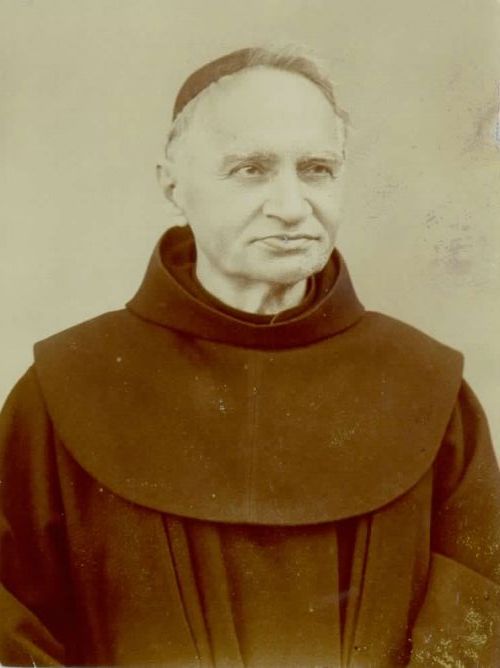
The library was named in honour of Father Stanislav Škrabec (1844–1918), the greatest Slovenian linguist and grammarian of the 19th century, who lived and worked in the monastery for 42 years. Father Škrabec made significant contributions to Slovene linguistic studies and the translation of religious texts into Slovene, helping to preserve and develop the Slovene language during a period of growing national consciousness.
Among the most compelling treasures is the grammar book by Adam Bohorič, written in Latin and titled Arcticae horulae succisivae from 1584, with an inscription of the author himself. In recent years, both the monastery and its library underwent careful renovation, preserving this irreplaceable cultural heritage for future generations.
Sacred Architecture & Recent Restoration
The architectural ensemble of Kostanjevica Monastery and the Annunciation Church represents a harmonious blend of Baroque architectural elements and Franciscan spiritual simplicity. The monastery's design reflects both its Carmelite origins and subsequent Franciscan influence, with the church serving as the spiritual heart of the complex.
Since 2017, the monastery's church has been under continuous restoration. The restorers, led by Emanuele Querini, relied on historical inventories and archival sources to establish the former appearance of the presbytery. They discovered up to seven layers of past repaints and renovations, then decided to remove three of them. During this careful process, they uncovered new decorations, inscriptions, and paintings long hidden from view.
"At first it looked like everything could be restored within two to three years. However, after the work started, it turned out that there was still damage from the First World War and a major earthquake. The decision to renovate was an extremely important one, and a bold one, but it was also high time to do it."
— Niko Žvokelj, Head of the Franciscan Monastery
Major discoveries include frescoes on the right and left sides of the presbytery in the lintel: the Heart of Jesus and the Heart of Mary. Some of the Bourbon family's symbols were also discovered anew during restoration of the frescoes in the church's nave and the lunette. The restoration has cost approximately €600,000, raised with the help of parishioners, the Culture Ministry, and the Nova Gorica municipality.
Among the key artistic features of the church are the large marble altar with a depiction of Mary and Child in a radiant golden frame, rich wall paintings and reliefs, and a ceiling fresco of the Coronation of Mary by the Friulian painter Giovanni Moro (1877–1949). The church also contains numerous tombstones of noble families.
The Bourbon Rose Collection
Since 2004, the former garden of the monastery features another highlight: the Bourbon rose collection, which is one of the most comprehensive and largest Bourbon rose collections in the world. This exceptional botanical collection reflects both the Nova Gorica coat of arms and the connection to Charles X, creating a living tribute to the French royal family whose members found their final resting place here.
A Monastery on the Frontier
Kostanjevica Monastery's position just 200 metres from the Italian-Slovenian border has made it a silent witness to some of the most significant events in modern European history. When the border was established in 1947, the monastery found itself on the Yugoslav side of the Iron Curtain, mere steps away from Italy and the West.
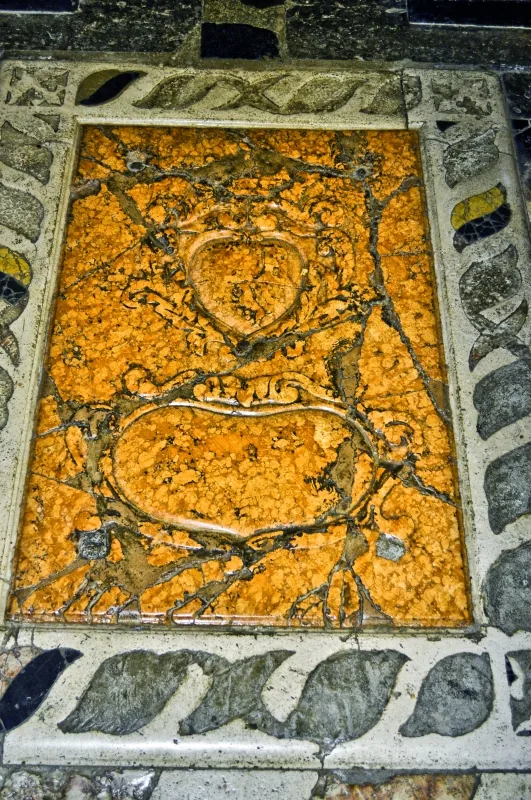
"On Sunday, 14 September [1947], many Slovenians came to bid farewell to Kostanjevica. With heavy hearts, after five Litanies of Loreto, the devotees of Kostanjevica returned across the already established demarcation line to Gorizia."
— Father Otmar Vostner, Chronicle of Kostanjevica
During the Cold War, this location gave the monastery particular significance — a spiritual sanctuary at the intersection of opposing political systems. In the first years of Yugoslavia, life at Kostanjevica was strongly shaped by the proximity of the border and the hostile attitude of the authorities toward the Church. Father Otmar Vostner, who arrived at Kostanjevica on 19 October 1945, was repeatedly fined for collecting donations without permission. Special rules applied to processions and bell ringing — he had to request permission even to ring the bells before midnight mass or on New Year's Eve.
Yet the monastery endured. Women and families who dared to help the Franciscans played a crucial role, cooking, cleaning, and supporting the monastery despite social pressure. The monastery's history reflects the broader experience of the Gorizia/Nova Gorica region: once unified, then divided by ideology, and today reunited in the borderless European Union. Visitors can stand on the monastery hill and contemplate how political borders have shifted around this sacred site, while the monastery itself has remained constant — a testament to the enduring power of faith beyond temporal political boundaries.
Sister City Partnership with Saint-Denis, France
In August 2024, Nova Gorica and the municipality of Saint-Denis (whose basilica served as the burial site for most French monarchs) signed an agreement to cooperate in tourism and culture. This partnership aims to encourage French visitors to discover Kostanjevica and its unique royal heritage. The agreement was signed at the Saint-Denis Town Hall north of Paris as part of events promoting Slovenian culture at the Slovenia House during the Paris Olympics.
Plan Your Visit
Visiting Hours for the Tomb and Library
- Monday–Saturday: 9:00 AM – 12:00 PM and 3:00 PM – 5:00 PM
- Sundays and Public Holidays: 3:00 PM – 5:00 PM
- Note: A prior notice of your visit is recommended, especially to view the library. Please call ahead to arrange an appointment, or ring the bell on arrival. Explicitly ask for both the library and the crypt, as they are shown separately.
The crypt may be closed on certain dates around Christmas and New Year. Check the monastery's official website for current information.
Getting There
The monastery is easily accessible from Nova Gorica. From Trg Evrope (Europe Square), where you can stand with one foot in Slovenia and one in Italy, you can walk to the monastery in about 15 minutes (it's uphill). You can also reach it by bike in approximately 30 minutes. There is parking available at the monastery for those arriving by car.
Highlights Not to Miss
The Bourbon Crypt
The only place outside France where a French king is buried. Six stone sarcophagi hold the remains of the last Bourbons, marked with their royal initials.
The Škrabec Library
Over 10,000 volumes including 30 incunabula, with the oldest dating to 1476. Home to Adam Bohorič's first Slovenian grammar (1584).
The Rose Garden
One of the world's most comprehensive Bourbon rose collections, blooming in the former monastery garden since 2004.
Panoramic Views
Breathtaking vistas over Nova Gorica, Gorizia, the Soča Valley, the Italian Veneto delta, and the Julian Alps.
Church Art Treasures
Baroque frescoes, stucco decorations, the Coronation of Mary ceiling fresco by Giovanni Moro, and recently restored hidden paintings.
Music Festival
Every year in May and June, the festival "Music from the Gardens of St. Francis" takes place in the monastery gardens.
Combine Your Visit
Kostanjevica Monastery pairs perfectly with other nearby attractions. Consider combining your visit with:
- Rafut Park — A nearby park with exotic plants and Neo-Islamic architectural influences
- Trg Evrope (Europe Square) — The iconic square where Slovenia meets Italy
- Sabotin Peace Park — A mountain park with history from the Battles of the Isonzo
- Nova Gorica city centre — A modernist town built from scratch after WWII
Legends and Stories of Kostanjevica
Several legends persist about the foundation of the church, all centred around the miraculous appearance of an image of the Virgin Mary. The name "Kostanjevica" itself comes from the Slovene word kostanj (chestnut), referring to the chestnut forest that once covered the hill. Historical sources state that Count Matija Thurn built the church in 1623, but the legends add a mystical dimension to this sacred place.
The hill and church have been known as "Kapela" (Chapel) since the beginning — a name that locals still use today instead of the formal "Church of the Annunciation of Our Lady." This endearing local name reflects the intimate connection between the people of Gorizia and Nova Gorica and their beloved sanctuary.
One of the most poignant chapters in the monastery's history involves the period after World War II. Father Otmar Vostner's chronicle records not only the sorrowful farewell of September 1947 but also the quiet heroism of ordinary people who supported the Franciscans through difficult times. From almost the very beginning of the new Yugoslav era, animals were kept at Kapela — a bull, two cows, and a pig. The friars suffered great deprivation. Only a few locals dared to help, as others feared losing their jobs. Times were hard, the regime severely restricted religious life, and a path to Kostanjevica reportedly had a woman who stood at a window every Sunday, noting who went to mass. Yet the monastery endured, as it had endured through wars, earthquakes, and political upheavals for four centuries.
Sources & References
Information compiled from: Official Kostanjevica Monastery website (samostan-kostanjevica.si), Vipava Valley Tourist Portal, Slovenia Times, STA News Agency, Wikipedia, Nova Gorica Archives, Culture.si, CERL Blog, and Wikimedia Commons. Images sourced from official tourism boards, Wikimedia Commons, and public domain collections.
For more information and to arrange visits: www.samostan-kostanjevica.si | Tourist Information Centre Nova Gorica