Where Two Nations Become One
Europe's unique cross-border capital
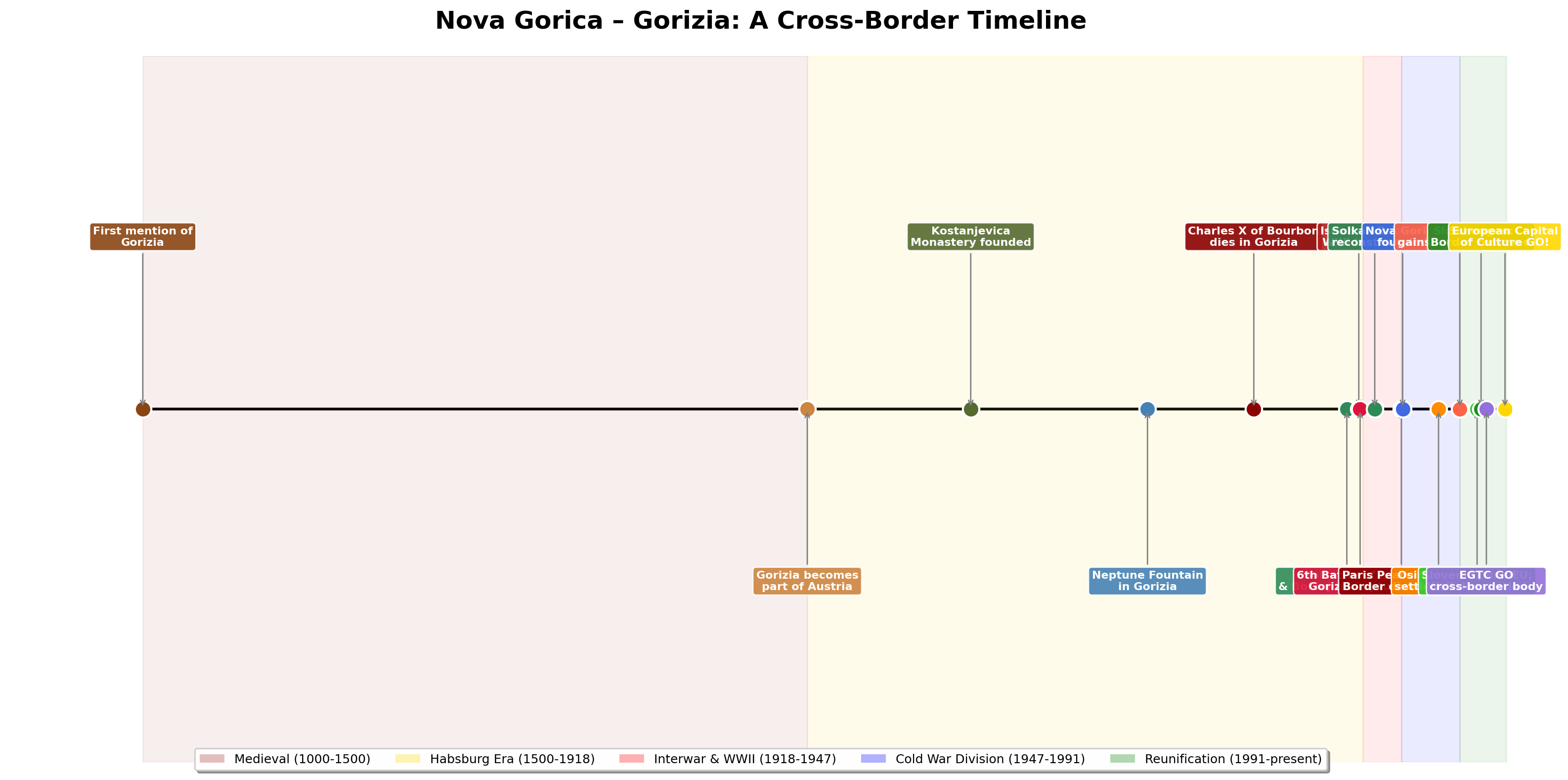
Nestled in the emerald-green northwestern corner of Slovenia, where the Julian Alps descend to meet the Adriatic Sea, lies a place unlike any other in Europe — a conurbation where a single city has been split between two nations yet functions as one cohesive whole. Nova Gorica on the Slovenian side and Gorizia on the Italian side form a cross-border urban area that stands as a powerful symbol of European integration. In 2025, this twin-city became the first-ever cross-border European Capital of Culture, operating under the theme "GO! Borderless".
What makes this region truly extraordinary is the profound narrative of division and reunification etched into its very fabric. A once-unified city was torn apart by the drawing of a border line after World War II, its communities separated by fences and watchtowers during the Cold War, only to emerge seven decades later as a beacon of cross-border harmony. Today, visitors can walk from Italy to Slovenia without encountering any border controls, crossing the iconic Europe Square (Trg Evrope / Piazza Transalpina) — a public space that quite literally straddles two nations.
The cross-border conurbation encompasses approximately 80,000 residents across both municipalities. Since 2011, the European Grouping of Territorial Cooperation (EGTC GO) has been working to transcend administrative boundaries and create a seamless cross-border urban space. The cities now share public services, cycling infrastructure, cultural programming, and a unified vision for sustainable development.
This guide invites you to discover the many layers of this fascinating region — from its turbulent history as a frontline in both World Wars and the Cold War, to its extraordinary natural beauty where the emerald Soča River carves its way through the Alps, to its vibrant gastronomic scene that blends Italian, Slovenian, and Austro-Hungarian influences into a unique cross-border cuisine.
The Europe Square
The only square in Europe split between two countries
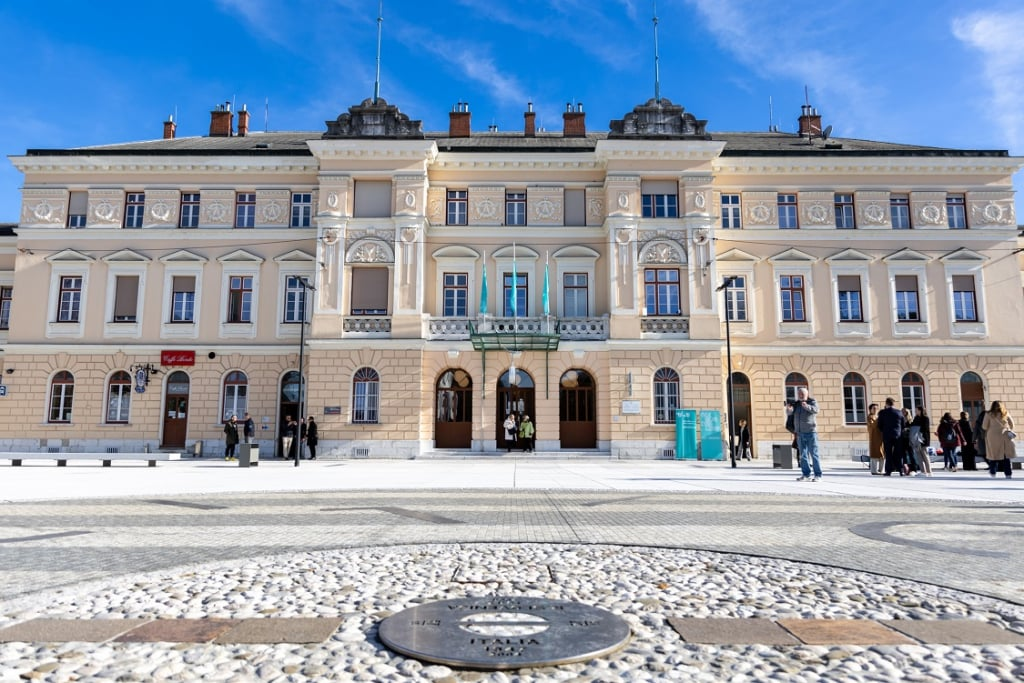
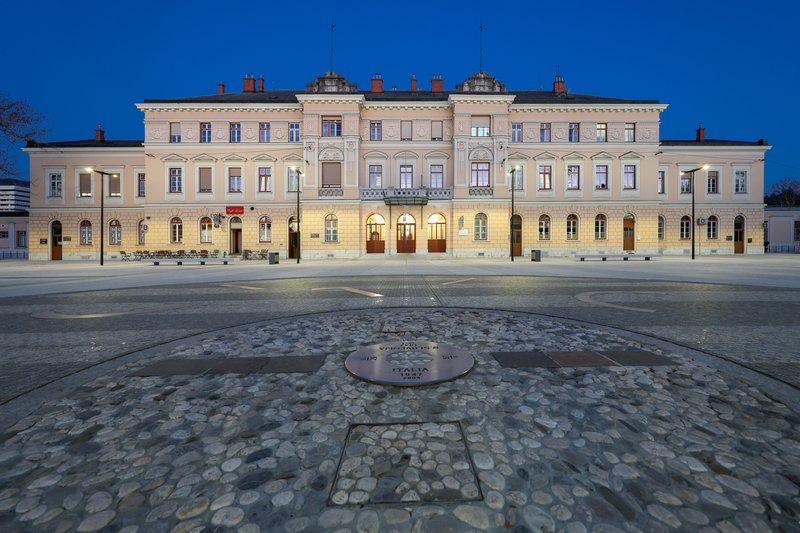
At the very center of the Nova Gorica–Gorizia conurbation lies a public square unlike any other in Europe. Europe Square — known as Trg Evrope in Slovenian and Piazza Transalpina in Italian — sits directly on the border between Italy and Slovenia, functioning as both a physical connection and a powerful symbol of European unity. The square was inaugurated in 2004 to celebrate Slovenia\'s accession to the European Union.
The most striking feature of the square is the Mosaic of the New Europe — a circular monument set into the pavement that marks the exact location of the former border. Visitors routinely position themselves with one foot in Italy and the other in Slovenia, capturing photographs that symbolize the borderless ideal. On the Italian side of the square, a curious sundial made from a steam locomotive power wheel tells the time differently in winter and summer.
The square sits directly in front of the Nova Gorica Railway Station, the oldest building in the young Slovenian city. This magnificent Secession (Art Nouveau) structure was originally built in 1906 as Gorizia\'s Northern Train Station during the construction of the Bohinj Railway, and it represents a direct physical link to the region\'s Habsburg past. The fan-shaped arrangement of streets radiating from the station was designed by the renowned architect Maks Fabiani.
Throughout 2025, Europe Square served as the primary venue for the European Capital of Culture celebrations. It hosted the inauguration ceremony on February 8, 2025, as well as Rossini\'s opera Il viaggio a Reims, a concert by pianist Alexander Gadjiev, the 14th stage of the Giro d\'Italia, and the "Jumping over Boundaries" sports event. The square also hosts the traditional annual Friendship March, which has been bringing together citizens from both sides of the border since the earliest days of cross-border cooperation.
The Thousand-Year-Old Italian City
Multicultural roots and Habsburg elegance
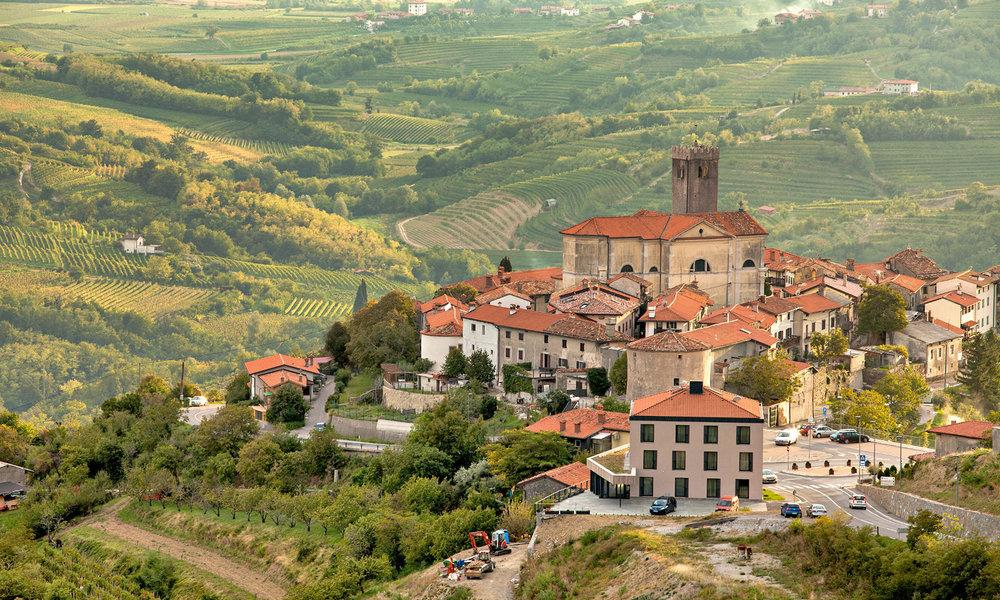
On the Italian side of the border, Gorizia (known historically by its Slovene name Gorica) stands as a city whose roots stretch back to the early Middle Ages, when it emerged as a strategic settlement controlling the passage between the Friulian Plain and the Soča Valley. The city\'s history has been profoundly shaped by its position at the crossroads of Germanic, Romance, and Slavic cultures — a multicultural character that developed most fully during the Habsburg era, when Gorizia became an important administrative and cultural center of the Austrian Empire.
Gorizia\'s golden age came under Habsburg rule, when the city earned the nickname "Austrian Nice" for its pleasant climate and scenic beauty. The Habsburg court attracted a cosmopolitan population of Italians, Slovenes, and Germans, who together created a uniquely multi-faceted urban culture. The city\'s legacy from this period is visible in its elegant architecture, beautiful gardens, and intellectual traditions.
The 20th century brought dramatic changes. During World War I, the city became one of the principal objectives of the Isonzo Front — a series of twelve brutal battles between Italian and Austro-Hungarian forces that ranks among the bloodiest campaigns in military history. Gorizia earned a darker nickname: the "Cursed City" (Maledetta Città). On August 9, 1916, Italian forces finally captured Gorizia — the only major city they would take during the entire war.
The aftermath of World War II brought an even more profound transformation. The 1947 Paris Peace Treaty drew a new border that divided the Gorizia region, assigning the historic city center to Italy while placing its northern suburbs within Yugoslavia. Families were separated, economic ties severed, and a community that had lived together for centuries was suddenly split between two opposing ideological blocs. Gorizia and its newly created Yugoslav counterpart, Nova Gorica, became known as the "Italian Berlin".
Gorizia Castle and the Borgo Castello
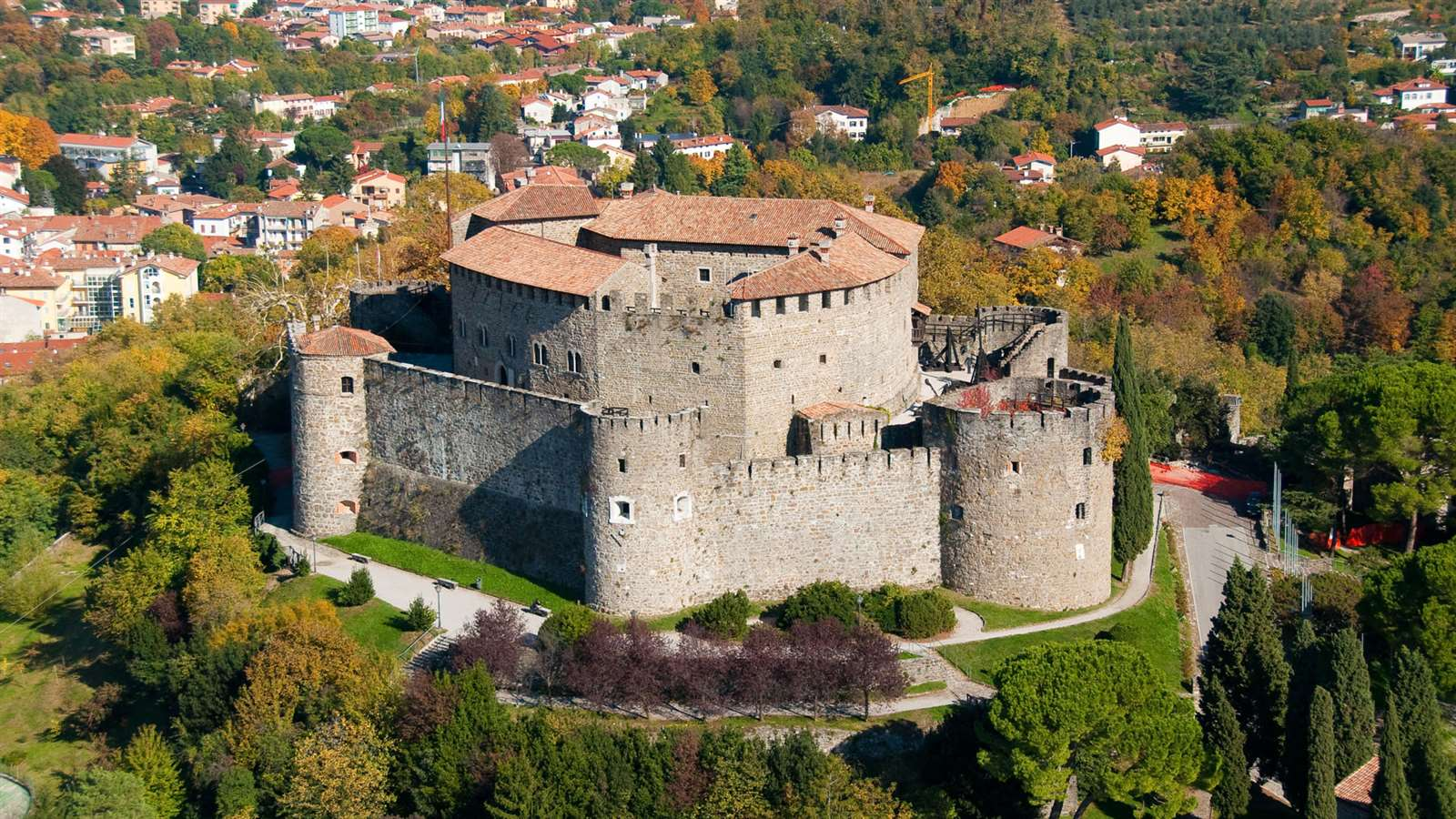
Dominating the city skyline from its hilltop perch, Gorizia Castle (Castello di Gorizia) is the city\'s most iconic landmark. Originally built in the 11th century and rebuilt in the 1920s, the castle offers panoramic views over the old town and across the border to Nova Gorica. Within the castle complex, visitors can explore the Museum of the Great War, the Archaeological Museum, the Museum of Fashion and Clothing, and Palazzo Attems Petzenstein.
Piazza della Vittoria and the Old Town
The historic center of Gorizia radiates from Piazza della Vittoria, the city\'s main square. The square\'s centerpiece is the Neptune Fountain, designed by Nicolò Pacassi and built by Marco Chiereghin in 1756. The adjacent Church of St. Ignatius, built by the Jesuits between 1654 and 1747, is the city\'s principal religious building and contains important frescoes and treasures of the Patriarchate of Gorizia.
Gardens and Jewish Heritage
Gorizia is renowned for its beautiful gardens, which reflect the city\'s Habsburg heritage. The Corso Verdi Public Gardens provide a verdant oasis, while the Palazzo Attems Petzenstein complex features elegant formal gardens. The city\'s garden culture reaches its peak during the annual "Gorizia Horts" event, when private gardens throughout the city open to the public.
Gorizia\'s once-thriving Jewish community left an indelible mark on the city\'s culture and commerce. The Gorizia Synagogue is one of the few remaining testimonies to a community that contributed significantly to the city\'s cosmopolitan character, while the Jewish cemetery on the slopes of the castle hill contains graves dating back to the 16th century.
Slovenia's Youngest City
A modernist planned city with a socialist soul
If Gorizia represents the weight of centuries, Nova Gorica embodies the optimism of modernism. Founded on June 13, 1948, Nova Gorica is the youngest city in Slovenia — and one of the youngest in Europe. Its creation was a direct consequence of the 1947 border settlement: when Gorizia was assigned to Italy, Yugoslavia needed a new urban center to serve the Slovene population of the Goriška region.
The urban plan for Nova Gorica was conceived by some of Slovenia\'s foremost postwar architects, who embraced modernist principles while adapting them to the local context. The city center is characterized by spacious parks, broad boulevards, and architecturally significant buildings that collectively create an atmosphere of openness and youthfulness. Unlike the dense medieval fabric of Gorizia, Nova Gorica was designed with ample green spaces, pedestrian-friendly layouts, and buildings separated by generous distances.
The city\'s defining visual motif is the rose. Nova Gorica is known throughout Slovenia as the "City of Roses" (Mesto vrtnic), with thousands of rose bushes planted throughout its parks and public spaces. This floral identity serves as a deliberate counterpoint to the concrete and fortifications of the Cold War era — a symbol of beauty and openness in a place once defined by division. Every year in May and June, the Festival of Roses transforms the city into a celebration of color and fragrance.
Casinos and Entertainment
Nova Gorica is Slovenia\'s undisputed capital of entertainment, with several major casino complexes that draw visitors from across Europe. The Perla Resort & Entertainment complex is the largest and most prestigious, offering a 4-star hotel, spa center (Sky Beach), multiple restaurants, and the most extensive gaming facilities in the country. The Park Hotel & Entertainment provides a more intimate 4-star experience with its own casino and fine dining options.
Culture and Architecture
The Slovene National Theatre Nova Gorica is one of Slovenia\'s most important cultural institutions, hosting a year-round program of theater, opera, ballet, and concerts. During GO! 2025, the theater has been a central venue, hosting the theatrical trilogy Inabili alla Morte and the year-long omnibus of international performances Destin(y)ation/Touch of Destiny, directed by Tomi Janežič.
Architecture enthusiasts will find Nova Gorica to be an open-air museum of socialist modernism. Key buildings include the Town Hall (1956), designed by Edvard Ravnikar; the railway station complex; the Hotel Perla; and numerous residential blocks. Guided architecture walks are available through the local tourist information center.
Just outside the city center, Kromberk Castle houses the collections of the Goriški Museum, the region\'s most important cultural institution. The museum\'s collections span the entire history of the Goriška region — from prehistoric artifacts through the Roman period, the medieval era, and into the modern age.
Europe's Emerald Jewel
A river of extraordinary beauty, history, and adventure
Flowing through the heart of the Nova Gorica–Gorizia region, the Soča River (Isonzo in Italian) is widely regarded as one of the most beautiful rivers in Europe. Its waters display an otherworldly emerald-green or turquoise color — a result of the limestone bedrock and glacial sediment — that has earned it the nickname "The Emerald Beauty." The river originates in the Trenta Valley deep within the Julian Alps and flows through the Soča Valley before crossing into Italy and emptying into the Adriatic Sea near Monfalcone.
The Soča River is more than a scenic backdrop — it is the defining natural feature of the entire region, shaping its landscape, its history, and its economy. The river valley served as the Isonzo Front during World War I, where some of the bloodiest battles in human history were fought. Today, that same valley has been transformed into the Walk of Peace from the Alps to the Adriatic, a 500+ kilometer trail that connects more than 300 monuments, cemeteries, ossuaries, and open-air museums along the former front line. The trail was added to the UNESCO World Heritage Tentative List in 2016.
The Soča River and its surrounding valley offer an extraordinary range of outdoor activities. White-water kayaking and rafting are the most popular pursuits, with the river\'s clear rapids providing challenges for everyone from beginners to Olympic-level athletes. The Solkan Kayak Center, located just below the Solkan Bridge, is a world-class facility that has hosted numerous international competitions. For a gentler experience, stand-up paddleboarding (SUP) expeditions allow exploration of the river\'s calmer stretches.
Canyoning in the Soča\'s tributaries offers an adrenaline-fueled combination of hiking, swimming, sliding down natural water chutes, and rappelling through waterfalls. The Tolmin Gorges provide some of the most spectacular canyoning experiences in the Alps. Fishing is another major attraction — the Soča is famous for its marble trout (Salmo marmoratus), a rare species endemic to the Adriatic basin. Fishing permits are required and the season runs from April through October.
| Site | Description | Distance from Nova Gorica |
|---|---|---|
| Sabotin Peace Park | Trenches, caverns, and panoramic views; accessible hiking trails | 5 km |
| Sveta Gora Tunnels | 260-meter underground tunnel beneath the basilica; WWI caverns | 4 km |
| Cerje Peace Monument | 25-meter observation tower with panoramic views and historical exhibitions | 15 km |
| Kolovrat Open-Air Museum | Preserved trenches and command posts with views of the Soča Valley | 20 km |
| Oslavia Ossuary | Italian military memorial containing remains of over 57,000 soldiers | 10 km (Italy) |
| Redipuglia Memorial | Italy's largest WWI memorial; massive terrace of graves | 25 km (Italy) |
| Škabrijel | Austro-Hungarian defense positions with commanding views | 8 km |
Key sites along the Walk of Peace near Nova Gorica–Gorizia.
An Engineering Marvel
The world's largest stone-arch railway bridge
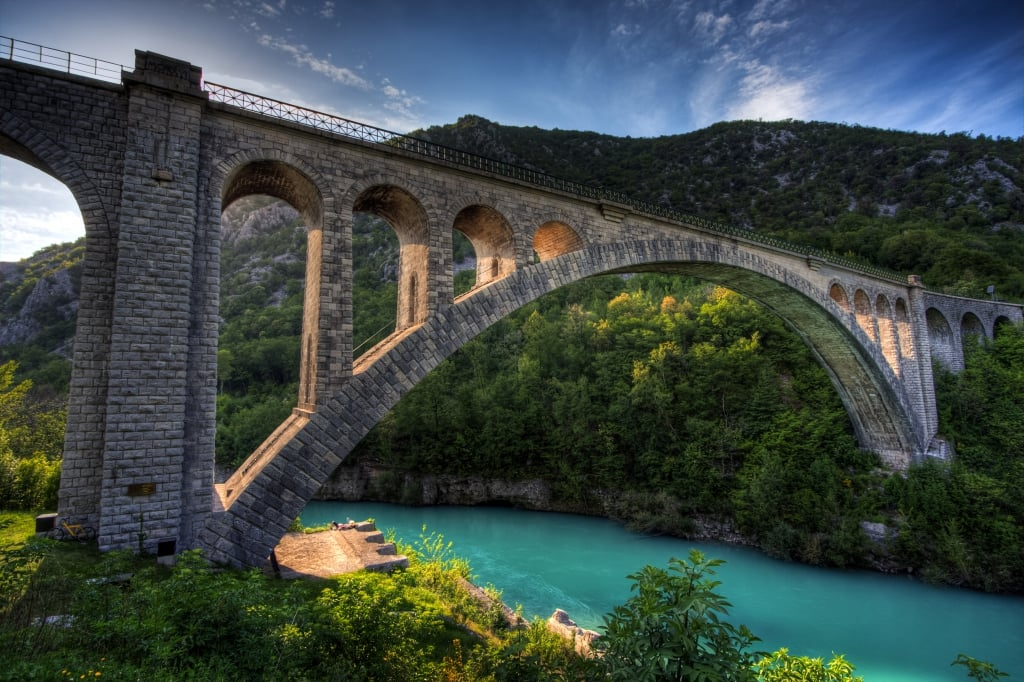
Spanning the emerald waters of the Soča River just north of Nova Gorica, the Solkan Railway Bridge (Solkanski most / Ponte di Salcano) stands as one of the greatest achievements of Austro-Hungarian civil engineering. Completed in 1906, the bridge\'s central stone arch spans 85 meters — making it the world\'s largest stone arch railway bridge, a record it has held for over a century. The bridge is composed of 4,533 precisely cut stone blocks sourced from the Roman Aurisina quarry.
The bridge was constructed as part of the Bohinj Railway (Bohinjska proga / Transalpina), a 717-kilometer railway connection linking Prague to Trieste via Jesenice and Gorizia. Built between 1900 and 1906 as the shortest connection between the Austro-Hungarian Empire\'s industrial heartland and the Adriatic Sea, the line features 28 tunnels, 5 galleries, and 65 bridges.
The construction presented extraordinary challenges. The geological conditions at the foundation site were unsuitable, forcing engineers Rudolf Jaussner and Leopold Örley to shift the bridge\'s alignment and increase the arch span from the originally planned 80 meters to 85 meters — an unplanned modification that secured the bridge\'s place in the record books. The bridge\'s Art Nouveau character is exemplified by its ornate cast-iron railing, decorated with stylized laurel wreaths originally designed by Otto Wagner.
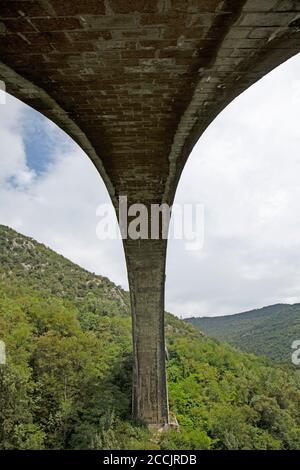
The Solkan Bridge\'s history is inseparable from the military conflicts that have defined this region. During the Sixth Battle of the Isonzo on the night of August 8-9, 1916, retreating Austro-Hungarian engineers blew up the bridge\'s magnificent arch using 930 kilograms of explosives. Following the breakthrough at Caporetto in October 1917, Austro-Hungarian forces regained control and installed a temporary iron lattice structure — restoring railway traffic within just two months. The arch was rebuilt in stone and reopened on August 8, 1927, eleven years to the day after its destruction.
Today, the Solkan Bridge is a technical monument of national importance in Slovenia. Visitors can experience the bridge by taking a scenic ride on the Bohinj Railway\'s museum train (operating May through November), walking along the riverbanks for spectacular views, or even bungee jumping from the adjacent road bridge — a 43-meter plunge toward the emerald waters below.
Slovenia's Wine Paradise
Indigenous grapes and a distinctive culinary identity
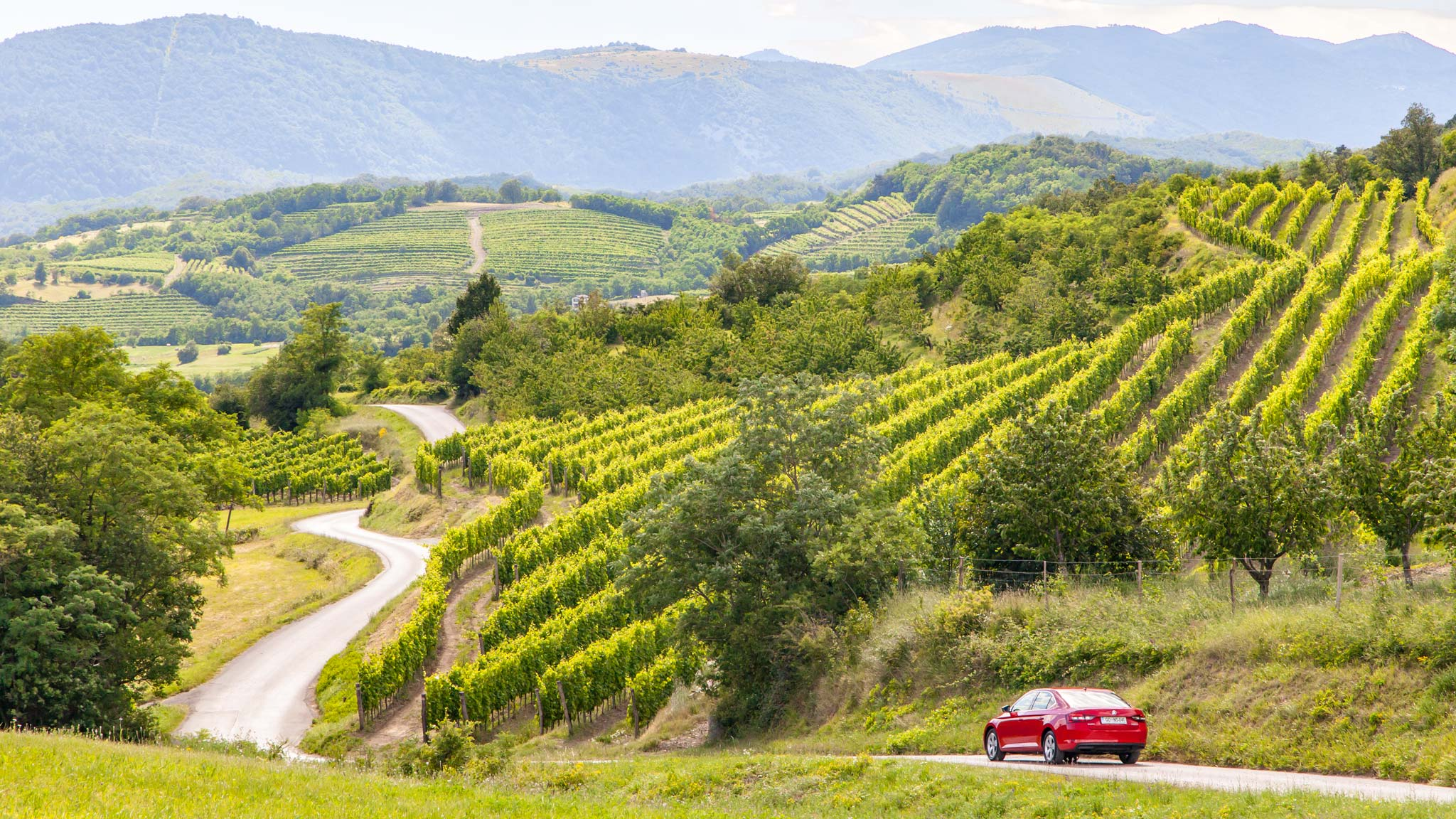
Southeast of Nova Gorica, the Vipava Valley (Vipavska dolina) unfolds as one of Slovenia\'s premier wine-producing regions — a sun-drenched corridor between the high Karst plateau and the hills of the Goriška region. The valley\'s unique geography creates a distinctive microclimate shaped by the Bora wind (burja) — a cold, dry northern wind — and the warm Mediterranean air rising from the Adriatic. This interplay produces wines that are gentle yet strong, complex yet approachable.
The Vipava Valley is famous for its indigenous white grape varieties, which are found almost nowhere else in the world. Zelen is the valley\'s signature grape, producing fresh, aromatic wines with distinctive herbal notes. Pinela offers delicate floral aromas and a crisp palate. Malvazija (Malvasia) produces fuller-bodied wines with Mediterranean character. Rebula (Ribolla Gialla) yields wines with excellent acidity and aging potential. In recent years, the valley has also gained recognition for natural and orange wines. Decanter magazine recognized three traditionally produced wines from the Vipava Valley as the best natural wines in the world.
The valley\'s restaurants range from acclaimed fine-dining establishments to rustic agritourism farms (turistične kmetije), where visitors can experience authentic home cooking paired with the farmer\'s own wines. The Osmica tradition — a seasonal farm-gate wine and food festival — allows visitors to taste local wines and products directly at the vineyard.
For independent travelers, many of the valley\'s family-run wineries welcome visitors for tastings and tours, often serving traditional home-cooked meals. For an exceptional fine-dining experience, Gostilna Pri Lojzetu — housed in a 17th-century frescoed manor house — is consistently ranked among Slovenia\'s best restaurants.
| Dish | Description | Best Season |
|---|---|---|
| Vipava Jota | A hearty stew of sauerkraut/turnip, beans, potatoes, and dried meat | Winter |
| Bleki | Homemade flat pasta noodles served with prosciutto and cream | Year-round |
| Vipava Prosciutto | Air-dried ham cured in the Bora wind | Year-round |
| Goriška Chicory (sukénski régut) | Red radicchio with a tangy, bitter flavor | Winter |
| Frittata (frtalja) | Herb-filled omelette made with wild herbs | Spring |
| Cottage Cheese Cake | Traditional dessert using fresh local cottage cheese | Year-round |
| Štruklji | Rolled dumplings with various fillings | Year-round |
Signature dishes of the Vipava Valley.
The Slovenian Tuscany
Rolling hills, medieval villages, and world-class wines
On the opposite side of the Soča River from the Vipava Valley, the Goriška Brda hills rise as one of Slovenia\'s most enchanting landscapes — and one of its most acclaimed wine regions. Often called the "Slovenian Tuscany," Brda is a patchwork of rolling vineyards, orchards, olive groves, and medieval villages. The region was named a European Destination of Excellence by the European Commission, and its wines consistently rank among the world\'s best.
Brda\'s winemaking tradition stretches back centuries, but the region has experienced a remarkable renaissance in recent decades. The cooperative Klet Brda is Slovenia\'s largest wine cellar, uniting 400 families who manage nearly 3,000 acres of vineyards. Famous Brda white wines include Ribolla Gialla (Rebula), Pinot Gris, Pinot Blanc, Chardonnay, and Sauvignon Blanc; the reds feature Merlot and Cabernet Sauvignon. The region\'s "opoka" soil — a unique overlay of clay, mud, and sand — imparts a distinctive earthy minerality.
Must-See Villages and Landmarks
The fortified village of Šmartno is Brda\'s most iconic settlement, completely surrounded by defensive walls with narrow cobblestone streets and stone houses. Šmartno hosts the annual "Brda and Wine" festival, attracting some 30 restaurants and 30 winemakers. Dobrovo Castle, a Renaissance fortress surrounded by a moat, houses the Klet Brda wine cellar and offers tastings. Vila Vipolže is considered the most beautiful Renaissance villa in Slovenia, and the Gonjače Lookout Tower rewards climbers with 360-degree panoramic views of the Brda hills, Julian Alps, Adriatic Sea, and Friulian Plain.
The best way to experience Goriška Brda is at a leisurely pace. The region offers 280 kilometers of cycling routes that wind through vineyards and villages, with e-bike rentals available. Wine safaris — guided tours that visit multiple wineries in a single day — offer an authentic introduction to the region\'s winemaking culture. The Cherry Festival in June and St. Martin\'s Day celebrations in November are particularly festive times to visit.
Sveta Gora and Sabotin
Pilgrimage, peace, and panoramic views
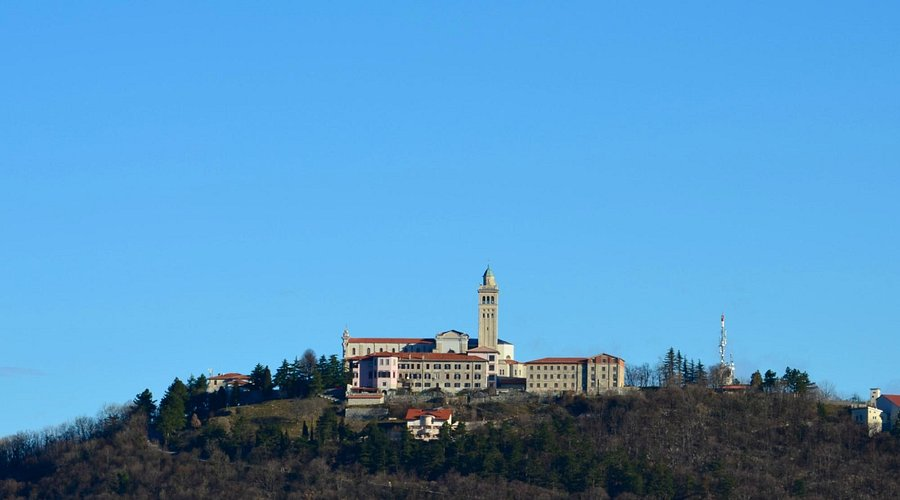
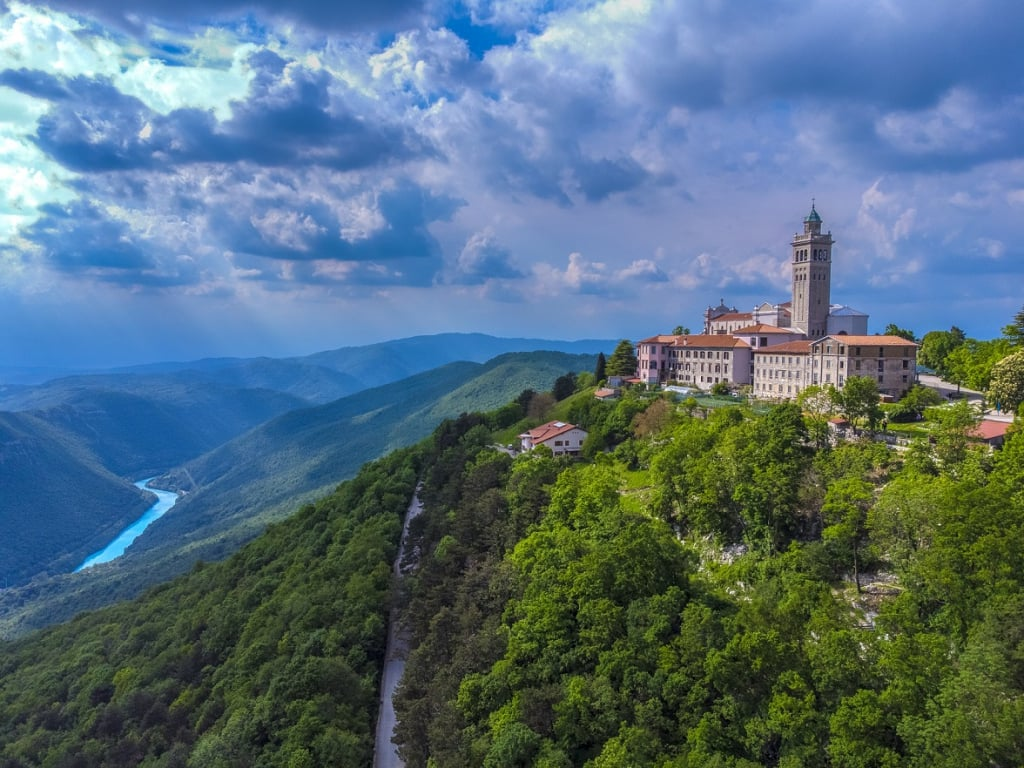
Rising to 682 meters on the eastern bank of the Soča River, Sveta Gora (Holy Mountain) is one of Slovenia\'s most important pilgrimage sites. According to tradition, in June 1539, a local shepherdess named Urška Ferligoj witnessed an apparition of the Virgin Mary. The present Basilica of the Assumption of Mary was built between 1924 and 1928 in the Neo-Baroque style, replacing an earlier structure destroyed during World War I.
The basilica contains several remarkable artistic treasures. The Late Gothic statue of the Mother of God with Jesus Christ and the famous painting of the "Queen of the Holy Mountain" by the Venetian master Palma Vecchio survive from the pre-WWI church. The adjacent Franciscan Monastery operates the Marian Museum, a fascinating collection of religious artifacts.
Sveta Gora is also significant for outdoor enthusiasts. The hill is crossed by the Walk of Peace and features numerous WWI trenches, caverns, and tunnels — including a popular 260-meter-long underground tunnel beneath the summit. Hiking trails of varying difficulty lead to the summit, and the views encompass the entire Goriška region, the Soča Valley, and the Julian Alps.
On the opposite side of the Soča River rises Mount Sabotin (609 meters), whose name is synonymous with peace. Sabotin Peace Park encompasses the entire summit area, which was the scene of fierce fighting during World War I. The Italian attack on Sabotin on August 6, 1916 — which lasted just 40 minutes — was the decisive action that led to the capture of Gorizia three days later. Today, the park preserves trenches, caverns, and command posts transformed from instruments of war into a place of reflection.
The summit of Sabotin offers what may be the best panoramic view of the entire cross-border region. From this single vantage point, visitors can see both Nova Gorica and Gorizia laid out below, with Europe Square visible in the distance. The view encompasses the Soča River valley, the pilgrimage basilica of Sveta Gora, the vineyards of Goriška Brda, the Friulian Plain, and on clear days, the Adriatic Sea. A road leads to the summit from Solkan, making the park accessible to visitors of all fitness levels.
Where French Royalty Rests
The Bourbon crypt and rose garden
On a hill just west of Nova Gorica, at an elevation of 143 meters and less than 200 meters from the Italian border, lies one of the most unexpected historical treasures in Europe. The Franciscan Monastery of Kostanjevica — known as the "Little St. Denis" — is the final resting place of the last members of the French royal House of Bourbon. The presence of a French king\'s tomb in this corner of Slovenia is a remarkable story of exile, political upheaval, and cosmopolitan connections.
The monastery was originally founded in 1623 when Count Matija Thurn commissioned a chapel and monastery, bestowing both upon Carmelite monks. In 1811, the complex was transferred to the Franciscans, who have maintained it ever since. The church and monastery were severely damaged during World War I, but were rebuilt in the 1920s. In 1985, the entire complex was declared a cultural and historical monument.
The monastery\'s fame rests on the Bourbon Tombs in the church crypt. The story begins with Charles X (1757–1836), the last King of France of the Bourbon dynasty. After his abdication following the July Revolution of 1830, Charles X went into exile, first in Edinburgh, then in Prague, and finally in Gorizia, where he died of cholera on November 6, 1836 — just seventeen days after his arrival. He was buried in the church of Kostanjevica on November 11.
In total, six sarcophagi in the crypt contain the remains of Bourbon family members. The presence of Marie Thérèse Charlotte — the daughter of Louis XVI and Marie Antoinette, and the only member of the French royal family to survive the Revolution — adds extraordinary historical significance to this modest Slovenian monastery.
The monastery houses the Škrabec Library, named after Father Stanislav Škrabec, Slovenia\'s most important linguist and grammarian. The library contains approximately 10,000 books, including 30 incunabula (books printed before 1501), the oldest dating to 1476. Since 2004, the monastery\'s former garden has featured one of the largest collections of Bourbon roses in the world, blooming spectacularly in May and June.
| Name | Title | Dates | Connection |
|---|---|---|---|
| Charles X | Last King of France (Bourbon dynasty) | 1757–1836 | Exiled after July Revolution 1830 |
| Louis XIX | Duke of Angoulême | 1775–1844 | Son of Charles X |
| Marie Thérèse Charlotte | Duchess of Angoulême | 1778–1851 | Daughter of Louis XVI and Marie Antoinette |
| Henri V | Count of Chambord | 1820–1883 | Last male Bourbon; grandson of Charles X |
| Louise Marie Thérèse | Duchess of Parma | 1819–1864 | Sister of Henri V |
| Marie Thérèse Beatrice Gaetana | Archduchess of Austria-Este | 1817–1886 | Wife of Henri V; built the crypt |
The six Bourbon sarcophagi in the Kostanjevica crypt.
The Cerje Peace Monument
A 25-meter tower of memory and hope
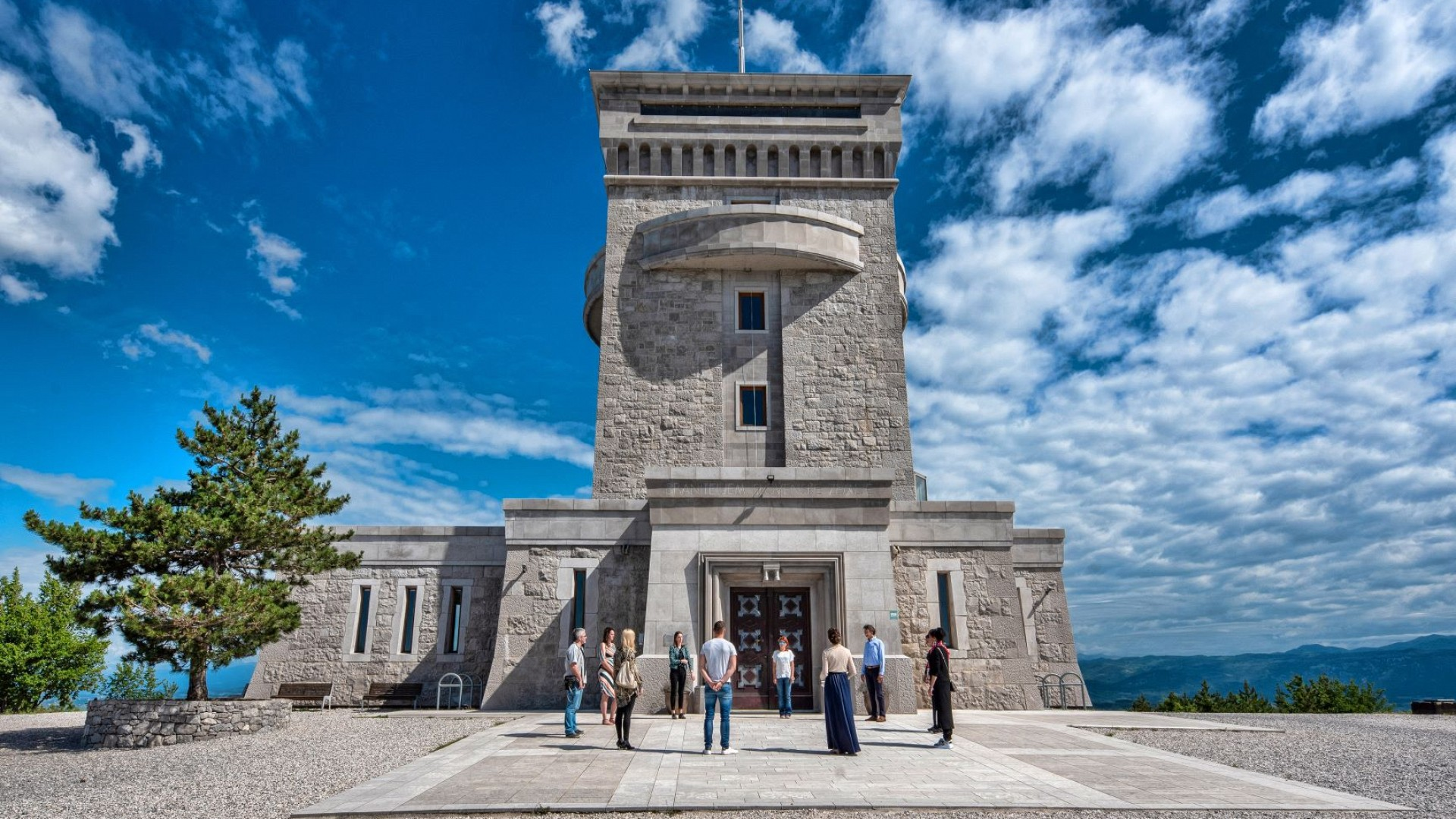
Perched on the edge of the Karst Plateau between the Vipava Valley and the Adriatic Sea, the Monument of Peace at Cerje stands as a powerful symbol of Slovenia\'s journey through conflict to independence. This 25-meter-high stone tower, visible from miles around, was built to preserve the memory of all defenders of Slovenian land throughout the nation\'s history. Its six floors take visitors on a chronological journey through Slovenian history — from prehistory and the Freising Manuscripts through World War I, the anti-fascist TIGR movement, World War II, and the Slovenian War of Independence.
The monument\'s ground floor features Rudi Španzel\'s monumental canvas "The Dance of Life and Death," dedicated to the Isonzo Front. The upper floors present exhibitions on modern Slovenian history, with particular emphasis on the anti-fascist TIGR movement — a revolutionary organization that was the first European resistance movement against fascism. The "People and War" exhibition in the cellar presents a moving exploration of war\'s impact on civilian life.
From the covered viewing platform at the top, the panorama stretches across four distinct geographical regions: the Vipava Valley with its vineyards and orchards; the Karst Plateau with its characteristic rocky landscape; the Friulian Plain extending into Italy; and on clear days, the Adriatic Sea and the Julian Alps. The Monument of Peace has received several prestigious awards, including the Kultura-Natura Association award for Preservation and Valorisation of Cultural Heritage (2018) and recognition from the Slovenia Tourist Association as the second-best attraction in Slovenia (2022).
Practical Information: The monument is located in Cerje, near Miren, 15 km from Nova Gorica. Summer hours (June–October) are Wednesday–Sunday, 10 AM–6 PM; winter hours are 10 AM–4 PM. It is closed Mondays, Tuesdays, and major holidays. Entrance fee is approximately 5 EUR (20% discount with Travel Loyalty Card). Guided tours are offered every Saturday in July and August at 10 AM, with registration required by Thursday.
Europe's Most Scenic Train Journey
A railway of imperial ambition
The Bohinj Railway (Bohinjska proga / Transalpina), of which the Solkan Bridge is the most celebrated element, ranks among the most spectacular railway journeys in Europe. This 717-kilometer line connecting Prague to Trieste via Jesenice, Nova Gorica, and Gorizia was built between 1900 and 1906 as the shortest connection between the Austro-Hungarian Empire\'s industrial heartland and the Adriatic Sea. The railway\'s construction required the excavation of 28 tunnels, the building of 5 galleries, and the construction of 65 bridges across some of the most challenging terrain in the Alps.
The longest tunnel on the line — the Bohinj Tunnel under Mount Kobla — stretches an impressive 6,327 meters through solid rock. At the time of construction, it was one of the longest railway tunnels in the world. The railway\'s most beautiful viaducts include the Mrtvaški (Dead Men\'s) Viaduct near Avče and the Kanal Viaduct. The line\'s descent from the Alpine watershed at Sorica to the Soča Valley and onward to Gorizia and Trieste represents a masterpiece of railway engineering.
Today, the Bohinj Railway museum train offers visitors the chance to experience this historic railway as it was in its golden age. Operating from May through November, the train is pulled by a steam locomotive from the Ljubljana Railway Museum (replaced by diesel during fire hazard periods). Passengers are welcomed aboard by a conductor in a vintage uniform, and the sound of an accordion adds to the nostalgic atmosphere.
The museum train can be boarded at Nova Gorica station — the same Secession building that faces Europe Square — making it an easy addition to any visit. The journey from Nova Gorica to Jesenice takes passengers across the Solkan Bridge, through the dramatic Baška Grapa valley, past Lake Bohinj — Slovenia\'s largest natural lake — and through the Julian Alps scenery that has made this one of Europe\'s most celebrated railway journeys.
Europe's Laboratory for Integration
EGTC GO and the GO! 2025 European Capital of Culture
The European Grouping of Territorial Cooperation (EGTC GO) represents the most advanced form of cross-border cooperation in Europe. Established in 2011 by the municipalities of Gorizia (Italy), Nova Gorica (Slovenia), and Šempeter-Vrtojba (Slovenia), the EGTC GO is a legal body with the authority to transcend national borders and implement joint policies in areas ranging from transport and environment to economic development and cultural programming.
The EGTC GO operates as an Italian public body with legal personality, which gives it the unique ability to implement projects on both sides of the border using a single legal framework. The results are visible in everyday life: a cross-border bike-sharing system allows users to pick up a bicycle in Slovenia and return it in Italy, with a single card and a single tariff. Mayors who once met two or three times a year now speak three times a day.
The 2025 European Capital of Culture designation represents the crowning achievement of the EGTC GO\'s work. Nova Gorica and Gorizia\'s joint bid — operating under the theme "GO! Borderless" — was the first-ever cross-border application in the history of the European Capital of Culture program. The designation was officially launched on February 8, 2025, with a year-long program of over 800 events spanning culture, arts, sports, gastronomy, and community engagement.
The EPIC Centre (European Platform for the Interpretation of the Century) serves as the program\'s flagship project. Located in a former railway warehouse in Nova Gorica, EPIC is a cross-border participatory project dedicated to the interpretation of 20th-century history. Its "City on the Border" permanent exhibition opened on Europe Day (May 9) 2025 and has become the cultural heart of the Capital of Culture year.
The Capital of Culture designation has already left lasting infrastructure. A new cross-border footbridge over the Soča River — costing 5 million EUR, of which 4.25 million came from EU funds — was constructed specifically for the 2025 celebrations. A new cross-border E-bus line launched in February 2025 offers regular, environmentally friendly connections between key urban centers and transport hubs on both sides of the border.
| Theme | Focus | Key Projects |
|---|---|---|
| War and Peace | The region's turbulent history and reconciliation | EPIC Centre permanent exhibition; Walk of Peace enhancements |
| Creating the New | Innovation, modernism, and contemporary creativity | Zoran Mušič exhibitions; Biennial of Young Artists |
| Smugglers | Border culture, exchange, and transgression | Cross-border cultural events and collaborative performances |
| Very Green | Sustainability and environmental consciousness | Zero-waste events; sustainable mobility; green urban initiatives |
The four themes of the GO! 2025 European Capital of Culture program.
Walking Across Borders
A new pilgrimage route for a borderless age
The Goriška Camino (Iter Goritiense) is one of the most innovative tourism initiatives to emerge from the GO! 2025 European Capital of Culture. This 82-kilometer cross-border pilgrimage route connects two UNESCO-recognized sacred sites: the Basilica of Aquileia in northeastern Italy and the Basilica of Sveta Gora above Nova Gorica. The route crosses the national border several times, passing through Gorizia and Nova Gorica and visiting numerous historical landmarks along the way.
The route is marked with Solomon\'s Knot, an ancient symbol of eternity that appears on the mosaics of Aquileia\'s basilica. Hikers receive a pilgrim passport in Aquileia and collect 12 stamps along the way, receiving a certificate of completion at Sveta Gora. Because it was not possible to place physical markers along the entire route, hikers can download GPX files from the itergoritiense.eu website. Due to the mild climate, the camino can be walked year-round.
The Goriška Camino connects with a broader network of pilgrimage routes in the region. The Path of the Three Sanctuaries (Pot treh svetišč) is a 34-kilometer route that links Sveta Gora with Marijino Celje on the Kanalski Kolovrat ridge and Castelmonte (Stara Gora) above Cividale in Italy. The Trail of Saint Martin circles the Vipava Valley and extends to Aquileia, passing over Sveta Gora. These interconnected routes position the Nova Gorica–Gorizia region as an emerging center of European pilgrimage tourism.
| Stage | Route | Distance | Highlights |
|---|---|---|---|
| 1 | Aquileia → Sagrado | 28 km | Flat terrain; Roman ruins of Aquileia; Friulian countryside |
| 2 | Sagrado → Miren | 24 km | Crosses into Slovenia via Kras/Carso; Cerje Peace Monument; Miren Castle |
| 3 | Miren → Gorizia | 13 km | Returns to Italy; Gorizia Castle; historic old town |
| 4 | Gorizia → Sveta Gora | 17 km | Crosses back to Slovenia; Nova Gorica; final climb to Sveta Gora basilica |
The four stages of the Goriška Camino.
Where Three Culinary Traditions Meet
Italian, Slovenian, and Austro-Hungarian fusion
The Nova Gorica–Gorizia cross-border region sits at the intersection of three major European culinary traditions: Italian (Mediterranean), Slovenian (Alpine-Pannonian), and Austro-Hungarian (Central European). This unique convergence has produced a fusion cuisine that exists nowhere else on the continent — a gastronomy that draws ingredients from the Adriatic Sea, the Alpine foothills, and the fertile plains of the Soča and Vipava valleys.
The region\'s signature ingredients tell the story of this crossroads. Rosa di Gorizia — a rare red radicchio introduced by the Habsburgs in the late 19th century — is grown only in a small slice of land around Gorizia and has been recognized as a Slow Food presidium. Vipava prosciutto, cured in the cold Bora wind, represents the Slovenian contribution to the cured meat tradition. Jota — a hearty bean and sauerkraut stew — appears on both sides of the border with minor variations. Brovada — turnips fermented in grape pomace — reflects the region\'s wine-making culture.
Wine is perhaps the most powerful expression of the region\'s cross-border identity. The Collio hills on the Italian side and the Brda hills on the Slovenian side are geographically a single wine-growing region divided by a political border. Both sides cultivate the same grape varieties — Pinot Grigio, Sauvignon Blanc, Friulano, Ribolla Gialla/Rebula, Malvasia, and Pinot Bianco — and produce crisp, mineral-driven whites shaped by the same "opoka" soil and Alpine-Mediterranean climate.
| Dish | Origin | Description |
|---|---|---|
| Jota | Both sides | Bean and sauerkraut/turnip stew with potatoes and dried meat |
| Rosa di Gorizia Salad | Italian side | Rare Habsburg-era radicchio with crispy pork lard and balsamic vinegar |
| Vipava Prosciutto | Slovenian side | Air-dried ham cured in the Bora wind |
| Frico | Italian side | Potato, onion, and Montasio cheese pancake |
| Bleki with Prosciutto | Slovenian side | Homemade flat pasta with Vipava prosciutto and cream sauce |
| Cjarsons / Žlikrofi | Both sides | Filled pasta/ravioli with sweet and savory fillings |
| Brovada | Both sides | Fermented turnips cooked with pork |
| Goulash | Austro-Hungarian | Paprika-spiced beef stew served with polenta or žganci |
| Presnitz / Presnec | Both sides | Spiral puff pastry with dried fruits, nuts, and rum |
| Štruklji | Slovenian side | Rolled dumplings with various fillings |
Signature cross-border dishes of the Nova Gorica–Gorizia region.
Adventure Awaits
Hiking, cycling, water sports, and adrenaline
The Nova Gorica–Gorizia region offers hiking opportunities for all abilities, from gentle valley walks to challenging Alpine treks. The Walk of Peace is the most significant long-distance trail, connecting hundreds of WWI heritage sites, but numerous other routes crisscross the region.
Cycling is one of the best ways to explore the cross-border region. The EGTC GO cross-border bike-sharing system allows cyclists to pick up bikes in one country and return them in the other. Key cycling routes include the Pedemontana Trail (181.9 km from Sacile to Gorizia), the Plave–Nova Gorica cycling trail (22.4 km), the Brda cycling network (280 km), and the Alpe Adria Cycle Path connecting Salzburg to the Adriatic.
The Soča River is the region\'s aquatic playground. Kayaking and rafting are available at all skill levels, from gentle family-friendly floats to challenging Class IV rapids. The Solkan Kayak Center offers equipment rental, instruction, and guided trips. Stand-up paddleboarding (SUP) on the calmer stretches provides a more relaxed water experience, while canyoning in the Soča\'s tributaries combines hiking, swimming, and rappelling through waterfalls.
For adrenaline seekers, the region offers bungee jumping from the Solkan road bridge (43 meters above the Soča), zip-lining at the Soča Fun Park, paragliding from hillsides above the Vipava Valley, via ferrata routes on Sabotin, climbing on Karst limestone cliffs, and skiing at nearby Kanin-Sella Nevea in winter.
| Trail | Distance | Difficulty | Highlights |
|---|---|---|---|
| Walk of Peace (local section) | 20–50 km | Easy to Moderate | WWI heritage sites, open-air museums, panoramic viewpoints |
| Goriška Camino | 82 km (4 stages) | Moderate | Pilgrimage route from Aquileia to Sveta Gora |
| Path of Three Sanctuaries | 34 km | Challenging | Connects Sveta Gora, Marijino Celje, and Castelmonte |
| Sabotin Peace Park trails | 5–10 km | Easy to Moderate | WWI trenches, panoramic views of both cities |
| Vipava Valley wine trails | Various | Easy | Vineyard walks connecting wineries and villages |
| Cerje educational trail | 3 km | Easy | Historical exhibitions, panoramic views |
| Nanos Plateau | 15–20 km | Challenging | Alpine scenery, Otliško Okno natural rock window |
Hiking opportunities in the cross-border region.
Planning Your Visit
Getting there, getting around, and where to stay
Getting There
The nearest airports are Trieste (TRS), approximately 45 km away, and Ljubljana (LJU), approximately 110 km away. Venice Marco Polo (VCE) is 170 km away and offers the widest range of international connections. All three airports have car rental facilities.
Nova Gorica is accessible by train from Ljubljana via the scenic Bohinj Railway (weekend direct service available). The Italian railway station in Gorizia connects to Trieste, Udine, and Venice. A new cross-border E-bus line launched in 2025 provides seamless connections between the two cities. By car, Nova Gorica is approximately 1 hour 15 minutes from Ljubljana via the A1 and A34 motorways, and about 1 hour 45 minutes from Venice.
Getting Around
The cross-border region is compact and easily navigable. The two city centers are within walking distance of each other (approximately 15 minutes on foot from Europe Square to Gorizia Castle). The new cross-border E-bus connects key locations on both sides, and the cross-border bike-sharing system provides easy access to bicycles. A car is recommended for exploring the surrounding wine regions and WWI heritage sites.
Language, Currency, and Borders
The region operates in three languages: Slovene on the Slovenian side, Italian on the Italian side, and English widely understood in tourist contexts. Euros (EUR) are used on both sides, as Slovenia adopted the euro in 2007. As both countries are members of the Schengen Area, there are no border controls — visitors can walk, cycle, or drive across without any formalities.
| Category | Options | Price Range (EUR/night) |
|---|---|---|
| Luxury/Resort | Perla Resort & Entertainment (4-star, casino, spa) | 150–300 |
| Boutique Hotels | DAM Boutique Hotel & Restaurant; Park Hotel & Entertainment | 120–200 |
| Mid-Range | Hotel Sabotin; Hotel Paquito; Garni Hotel Siesta | 70–130 |
| Budget | Hostel Point; Guest House Sterk; Lipa Hotel & Bistro | 40–80 |
| Agritourism | Turistične kmetije in Vipava Valley and Brda | 60–120 |
| Pilgrimage Hostel | Sveta Gora (28 beds, renovated for Goriška Camino) | 20–40 |
Accommodation options in the cross-border region.
Best Time to Visit
Seasonal considerations for your trip
The Nova Gorica–Gorizia region is a year-round destination, with each season offering a distinct experience. Spring brings blooming roses and ideal weather for hiking and cycling; summer is peak season for outdoor adventures and festivals; autumn is the best time for wine tourism and harvest events; winter offers lower prices, Christmas markets, and nearby skiing.
| Season | Advantages | Considerations |
|---|---|---|
| Spring (April–May) | Mild weather; blooming roses; ideal for hiking and cycling | Some mountain trails may still have snow |
| Summer (June–August) | Warm weather; peak season for outdoor activities; festivals | Higher prices; more crowds; afternoon thunderstorms possible |
| Autumn (September–October) | Best time for wine tourism; beautiful foliage; mild temperatures | Some outdoor activity operators begin to close |
| Winter (November–March) | Lower prices; Christmas markets; skiing at nearby Kanin | Shorter daylight; some attractions closed; cold and wet weather |
Best times to visit the Nova Gorica–Gorizia cross-border region.
A Borderless Future
The lasting impact of GO! 2025
As the GO! 2025 European Capital of Culture year draws to a close, the question of legacy becomes paramount. The EGTC GO has been deliberate in ensuring that the Capital of Culture designation leaves permanent improvements, not merely memories. The new cross-border footbridge over the Soča River, the E-bus line, the renovated EPIC Centre, and the redeveloped Europe Square are all physical legacies that will continue to serve residents and visitors for decades to come.
Beyond infrastructure, the cultural year has strengthened the cross-border identity that the EGTC GO has been cultivating since 2011. The "Borderless" concept — which was merely aspirational when first proposed — has become a lived reality for thousands of residents who participated in cross-border events, volunteered in joint projects, and experienced their twin city as a single cultural space.
The success of Nova Gorica–Gorizia has not gone unnoticed. In January 2026, an exhibition titled "European Capital of Culture 2025 – Nova Gorica-Gorizia as a European model of cross-border cooperation" opened at the Council of Europe in Strasbourg, highlighting the initiative as a paragon of European integration. As Mayor Samo Turel of Nova Gorica observed: "In today\'s Europe, when more fences are being built, we are rowing against the flow." The Nova Gorica–Gorizia cross-border region stands as proof that even the most painful divisions can be healed through cooperation, culture, and the patient work of building connections across borders.