PittaPoesia
Omaggio agli Antichi Sumeri
Where painting meets poetry in homage to the world's first civilization
A Dialogue Between Painting, Poetry, and the Dawn of Writing
PittaPoesia — Omaggio agli Antichi Sumeri is a unique permanent art exhibition running from May 16, 2025 to December 31, 2026 at the Hotel Major in Ronchi dei Legionari, Province of Gorizia. The exhibition is part of GO! 2025 — European Capital of Culture, the first cross-border European Capital of Culture in history, jointly held by Nova Gorica (Slovenia) and Gorizia (Italy) under the theme "GO! Borderless."
The word PittaPoesia is a neologism coined by artist Giorgio Bottò and poet Pierpaolo Freschi, combining the Italian words for painting (pittura) and poetry (poesia). This original artistic concept fuses figurative art with poetic verse, creating mixed-media works where paintings and poems dialogue with each other — sometimes the poetry follows the visual artwork, other times the painting itself integrates the poetic text. The result is a deeply layered artistic experience that transcends traditional boundaries between visual and literary arts.
A First Look at PittaPoesia
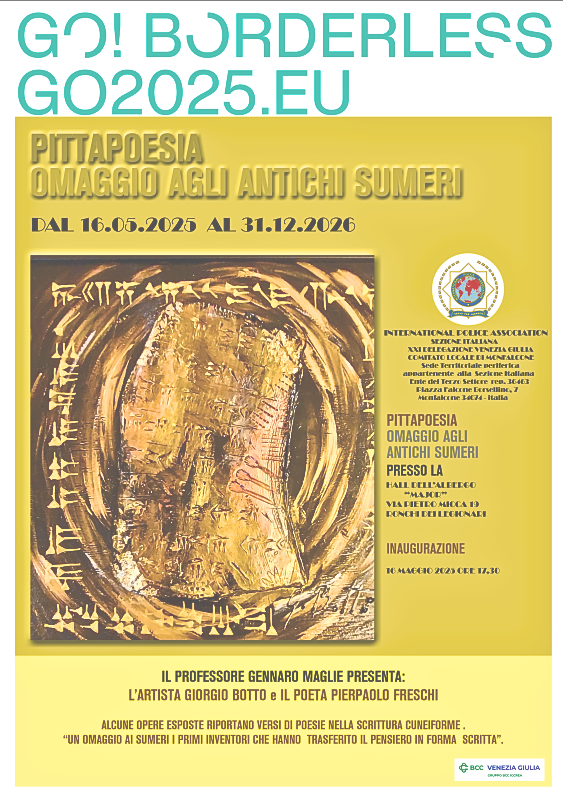
The official GO! 2025 exhibition poster showing a Sumerian-themed terracotta tablet artwork.
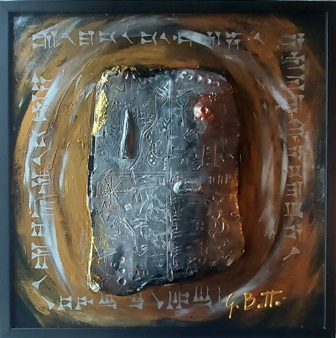
An example of Giorgio Bottò's Sumerian-themed artwork with cuneiform writing and gold leaf.
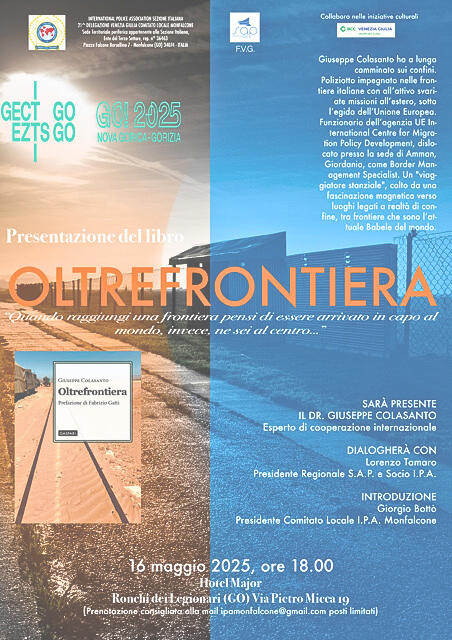
The flyer for the book presentation of OltreFrontiera by Dr. Giuseppe Colasanto.
Giorgio Bottò & Pierpaolo Freschi
Giorgio Bottò — Painter
Giorgio Bottò is a contemporary Italian painter based in Ronchi dei Legionari, in the Province of Gorizia. His artistic journey emerged after a long career in public service, when encounters with painters and musicians rekindled his creative determination. Bottò's work is characterized by vivid, luminous colors that, in his own words, bring "light into a dark world where everything is difficult and bring joy."
His paintings span abstract, figurative, and material styles, often incorporating unusual materials that give his works remarkable texture and scenic depth. In recent years, Bottò has developed a passionate interest in archaeology and ancient civilizations, particularly the Sumerian civilization. His recent works feature inserts of cuneiform script in the Sumerian language dating back to 3000 BCE, combined with contemporary painting techniques. Many pieces are embellished with 23-karat gold leaf that catches the light differently from every viewing angle.
Bottò's works are exhibited in important institutional settings including embassies and consulates across Europe. His art can be found in collections in Austria, Germany, Hungary, Luxembourg, France, and Italy. He has been selected to participate in European biennials in Paris, Barcelona, London, and Venice.
Pierpaolo Freschi — Poet
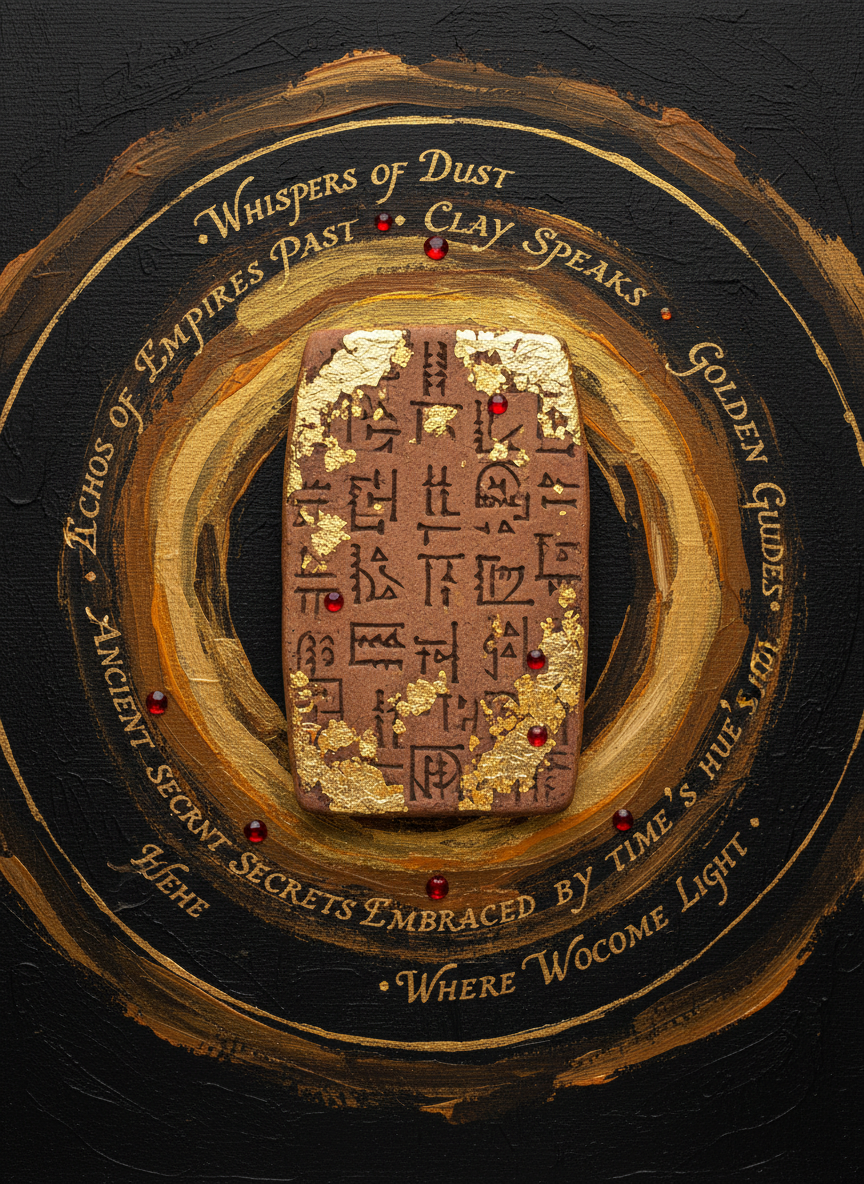
Pierpaolo Freschi is the poet whose verses breathe literary life into the PittaPoesia project. His poetry accompanies Bottò's visual works, with verses translated into Sumerian cuneiform characters and integrated directly into the terracotta tablet artworks. The collaboration represents a genuine dialogue between visual and literary arts, where neither element is subordinate to the other — instead, they exist in a symbiotic relationship that enriches both.
Freschi's poems have been translated into Hungarian for the Pécs exhibition, demonstrating the international resonance of this local artistic collaboration. His verses often reflect on themes of time, eternity, human existence, and the enduring power of ancient civilizations — themes that find perfect visual correspondence in Bottò's Sumerian-inspired imagery.
Key Sumerian-Themed Works by Giorgio Bottò
| Title | Date | Size | Technique | Sumerian Reference |
|---|---|---|---|---|
| Inanna | Jan 2024 | 40×40 cm | Acrylic on wood with terracotta and 23-karat gold leaf | Goddess of love, fertility, war, and civilization |
| Ishtar | Jan 2024 | 40×40 cm | Acrylic on wood with terracotta | Goddess of love, fertility, and war — protector of the Sumerians |
| AN | Jan 2024 | 40×40 cm | Acrylic on wood, terracotta, 23-karat gold leaf | The sky god, supreme deity of the Sumerian pantheon |
| ENKI | Jan 2024 | 40×40 cm | Acrylic on wood, terracotta, silver leaf | God of wisdom, water, and creation |
| Lugal | Mar 2024 | 40×40 cm | Acrylic on wood with terracotta and silver leaf | "King" in Sumerian |
| TAMTUM | May 2025 | 40×40 cm | Acrylic with gold leaf | Sumerian-Akkadian concept |
| Sacred Marriage | Apr 2024 | 40×40 cm | Acrylic on wood with terracotta and gold leaf | The sacred ritual of Sumerian kingship |
| Zisurru' | Apr 2024 | 80×80 cm | Acrylic with gold leaf | Sumerian word related to boundaries |
| MU DU - A | May 2025 | 40×40 cm | Acrylic with gold leaf | Sumerian phrase |
| LU | May 2025 | 40×40 cm | Acrylic with gold leaf | "Man" in Sumerian |
| Alfabeto delle Origini | Aug 2025 | 114×94 cm | Acrylic with gold leaf | "Alphabet of Origins" |
The Sumerian Civilization
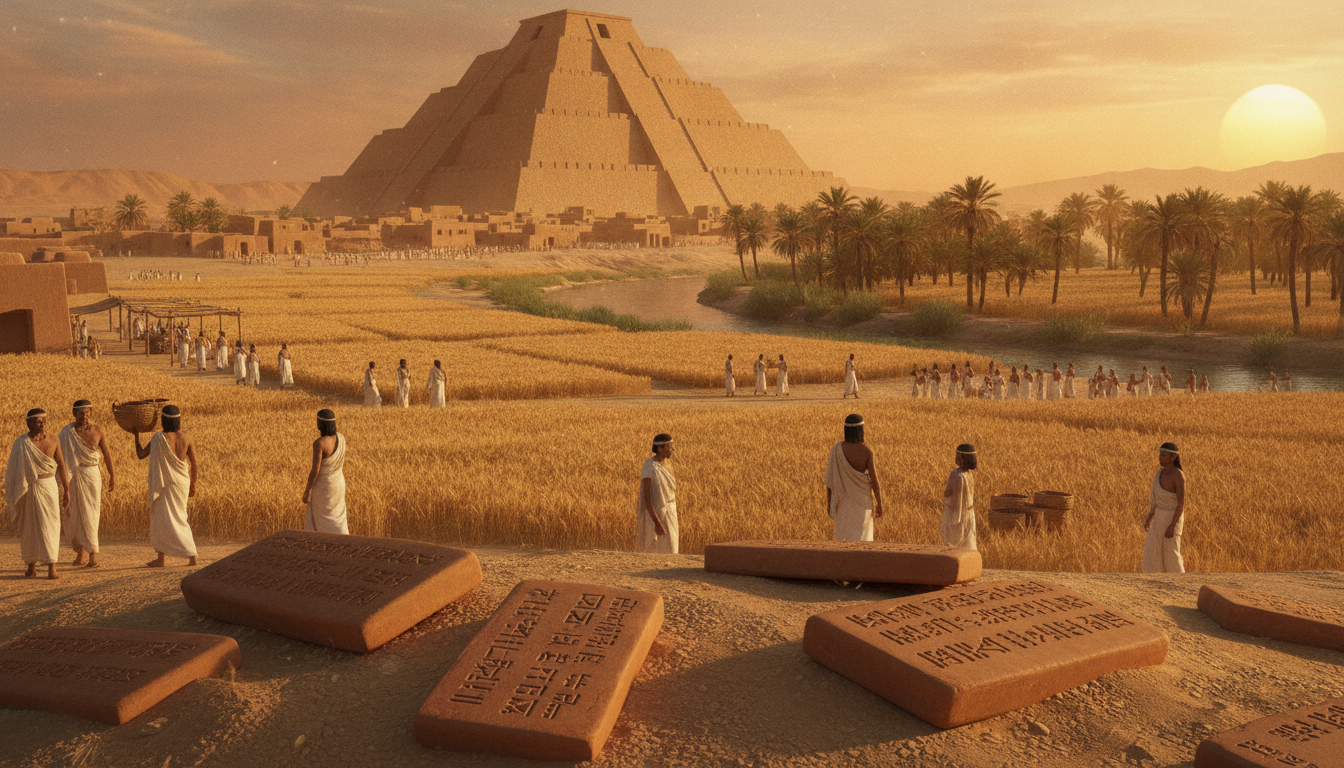
The Sumerians (circa 4500–1900 BCE) established the world's first known civilization in Mesopotamia, the land between the Tigris and Euphrates rivers, in what is now modern-day Iraq. Their legacy shaped human history in profound ways, and their story resonates powerfully with the borderless theme of GO! 2025.
Birth of Writing: Cuneiform
The Sumerians invented cuneiform, the world's first system of writing, around 3400–3200 BCE. The name derives from the Latin word cuneus ("wedge"), describing the wedge-shaped impressions made by a stylus pressed into soft clay tablets. This revolutionary invention allowed humans to record language, preserve knowledge, conduct commerce, and create literature for the first time in history.
Cuneiform began as pictographs — simple drawings representing objects and concepts — but gradually evolved into a sophisticated system of abstract signs representing syllables and ideas. The Sumerians used cuneiform to write everything from administrative records and legal codes to mythological narratives and literary works like the Epic of Gilgamesh, considered the world's oldest known piece of literature.
Sumerian Deities in the Exhibition
| Deity | Domain | Symbolism in Art |
|---|---|---|
| Inanna/Ishtar | Love, fertility, war, resurrection, law, civilization | The most powerful goddess — lady of heaven who unified opposites, bringing both creation and destruction |
| An | The sky, supreme authority | Father of the gods, representing cosmic order and divine kingship |
| Enki | Wisdom, water, creation, magic | The god who brought civilization and knowledge to humanity, patron of crafts and arts |
| Lugal | Kingship, sovereignty | The earthly ruler who mediates between divine and human realms |
Sumerian Achievements
| Achievement | Significance |
|---|---|
| Cuneiform Writing | World's first writing system — enabled record-keeping, literature, law |
| The Wheel | Revolutionized transportation and pottery production |
| Mathematics | Base-60 number system still used for time (60 seconds, 60 minutes) and angles (360 degrees) |
| Astronomy | First systematic observations of celestial bodies |
| Architecture | Ziggurats — massive stepped temple structures reaching toward the heavens |
| Law | Some of the world's earliest written legal codes |
| Agriculture | Sophisticated irrigation systems enabling surplus and urbanization |
| The city-state | The political model of organized urban civilization |
Hotel Major, Ronchi dei Legionari
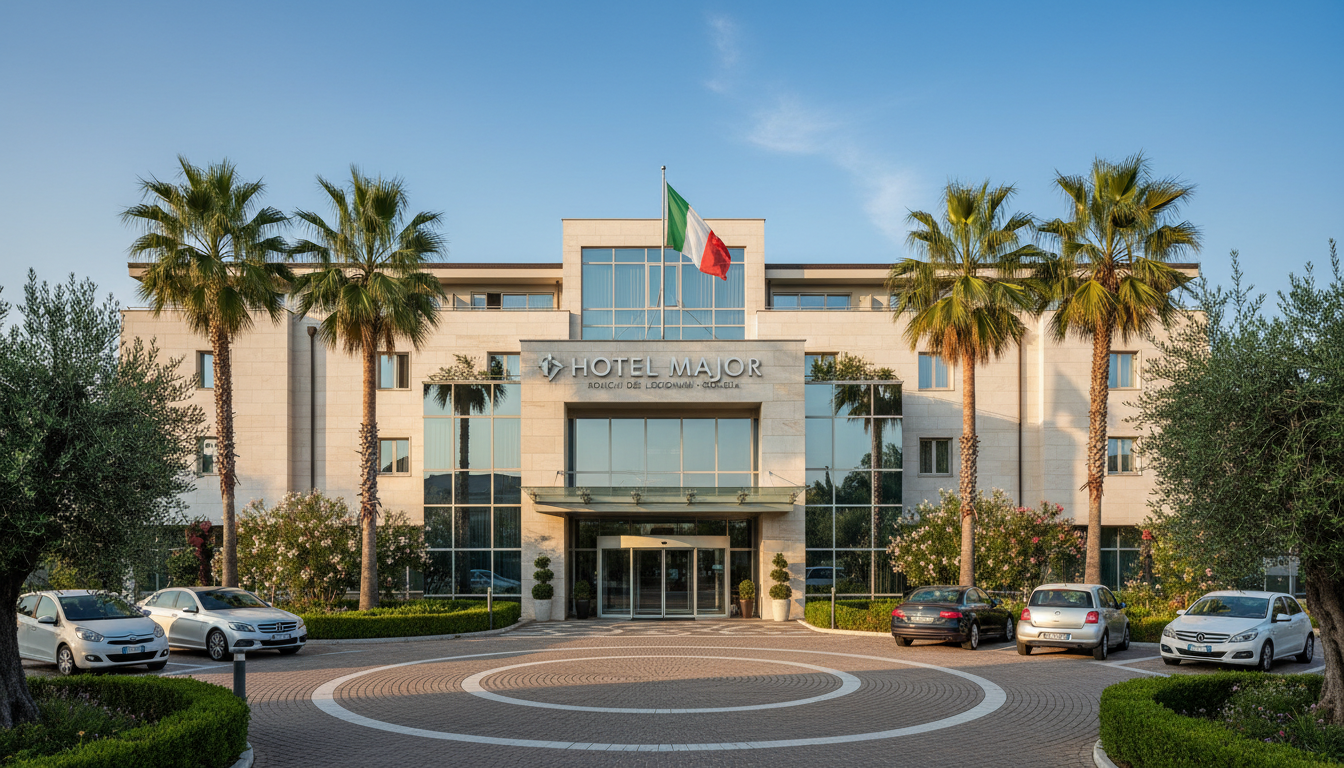
The Hotel Major is a 4-star hotel located in Ronchi dei Legionari, in the Province of Gorizia, just 3 km from Trieste Airport (Friuli Venezia Giulia Airport) and 800 meters from the Redipuglia-Monfalcone West highway exit on the A4 motorway. Its strategic location makes it an ideal cultural venue for the cross-border GO! 2025 initiative.
For the PittaPoesia exhibition, Hotel Major offers its ground-floor spaces, including the hotel hall and restaurant room, as a gallery for the works. This unique setting transforms everyday hospitality spaces into a cultural destination, allowing visitors to encounter ancient Sumerian art while enjoying the hotel's amenities. The exhibition's placement in a hotel — a place of transit and meeting — subtly echoes the Sumerian legacy as a crossroads of civilizations.
The hotel features 96 rooms, modern furnishings, meeting facilities, a restaurant combining Central European and regional cuisine, and is notably close to significant cultural sites including the Redipuglia Military Shrine (1.5 km), Monfalcone (8 km), Gorizia Castle (16 km), and Nova Gorica (17.6 km).
GO! 2025 — Europe's First Borderless Capital of Culture
GO! 2025 is a historic initiative: the first cross-border European Capital of Culture ever held. The project unites Nova Gorica (Slovenia) and Gorizia (Italy) — two cities separated by a national border but bound by shared history, culture, and daily life. The initiative operates under the theme "GO! Borderless," reflecting the long-term effort to overcome divisions and build a shared cultural space.
The official opening took place on February 8, 2025 — the Slovenian cultural holiday Prešeren Day — at five venues across both cities, attended by approximately 50,000 people. During the title year, more than 1,600 events are being held on both sides of the border, attracting over 1.5 million visitors.
GO! Borderless and the PittaPoesia Exhibition
Temporal Borderlessness
Bridges 5,000 years of human history, connecting contemporary art with the world's first civilization.
Artistic Borderlessness
Dissolves the boundaries between painting and poetry, visual and literary arts.
Geographic Borderlessness
Contributes to a cultural programme that transcends national borders between Italy and Slovenia.
Institutional Borderlessness
Demonstrates how diverse organizations can unite around cultural goals.
The Opening Event — May 16, 2025
The inauguration of the PittaPoesia exhibition on May 16, 2025 was an evening of extraordinary cultural richness. The event was a double cultural happening organized by the Local Committee of the International Police Association (IPA) of Monfalcone and the Sindacato Autonomo di Polizia (SAP) Friuli Venezia Giulia.
The evening opened with the PittaPoesia — Omaggio agli Antichi Sumeri exhibition, introduced by Professor Gennaro Maglie, who guided the audience through a fascinating journey into Sumerian history and culture. Following the exhibition presentation, Dr. Giuseppe Colasanto presented his book "OltreFrontiera" — a powerful memoir of his career as a border policeman engaged in Italian and European Union missions abroad, and as an official of the EU agency International Centre for Migration Policy Development in Amman, Jordan.
The evening was masterfully conducted by Lorenzo Tamaro, Regional Secretary of SAP, in dialogue with Giorgio Bottò, President of the Local IPA Committee of Monfalcone.
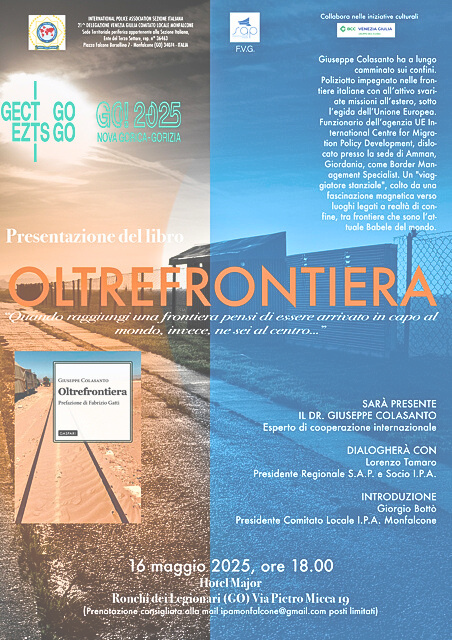
OLTREFRONTIERA — Beyond the Border
"OltreFrontiera" by Dr. Giuseppe Colasanto is a profound reflection on borders — both geographical and interior. Colasanto, described as a "sedentary traveler" magnetically drawn to border realities, shares his experiences walking the borders of the world. A policeman engaged at Italian borders with multiple missions abroad under the European Union, he also served as an official of the EU agency ICMPD in Amman, Jordan, as a border management specialist.
His book explores how borders, which represent "the current Babel of the world," can become spaces of encounter rather than division. The book presentation and art exhibition together created a powerful dialogue between visual arts, literature, and lived experience — all converging on the theme of borders, crossings, and the human need to transcend divisions.
The International Police Association and Art
The International Police Association (IPA) is the world's largest organization for police officers, founded in 1950 with the motto "Servo per Amikeco" (Service through Friendship). The Local Committee of Monfalcone has been notably active in cultural initiatives, organizing art exhibitions, poetry events, and charitable activities that bring together police officers and the wider community.
The collaboration between the IPA Monfalcone Committee and artist Giorgio Bottò represents a unique model of police-community cultural engagement. Through art, the IPA builds bridges — quite literally in the case of GO! Borderless — between law enforcement and the communities they serve. The organization has sponsored numerous exhibitions featuring Bottò's work, helping bring his Sumerian-themed art to international audiences.
Sumerian Art and Architecture
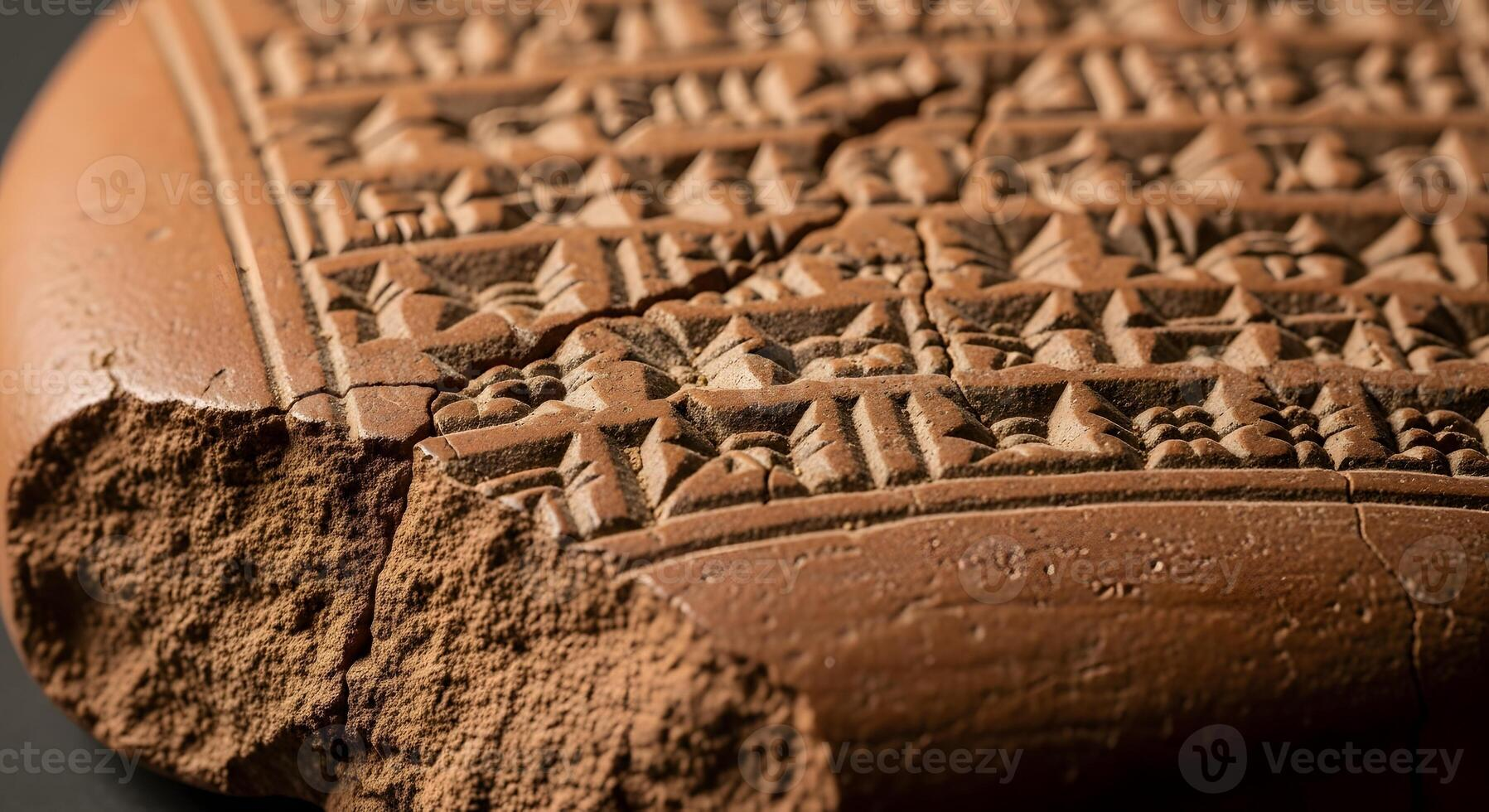
Ancient Sumerian cuneiform clay tablet showing wedge-shaped writing.
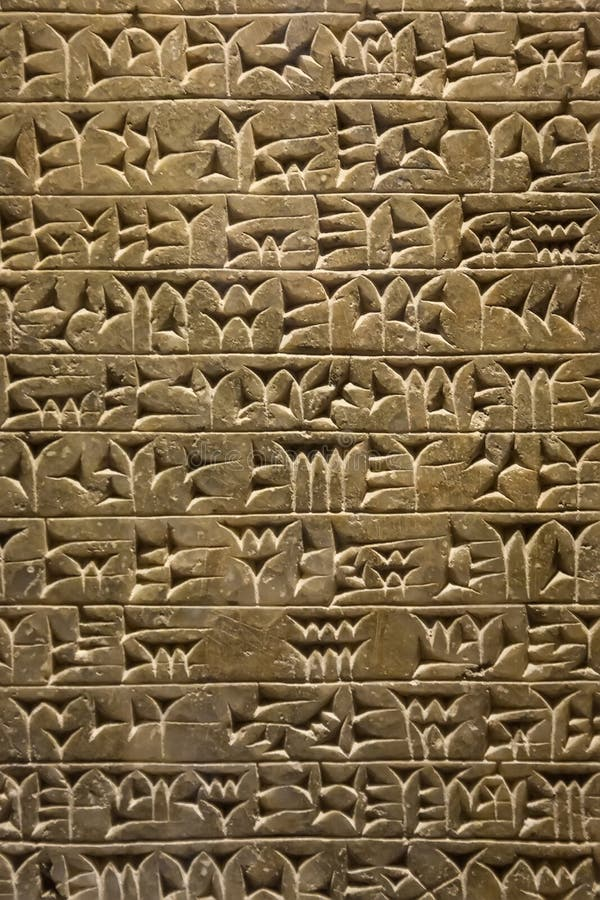
Detailed view of cuneiform script — the world's first writing system.
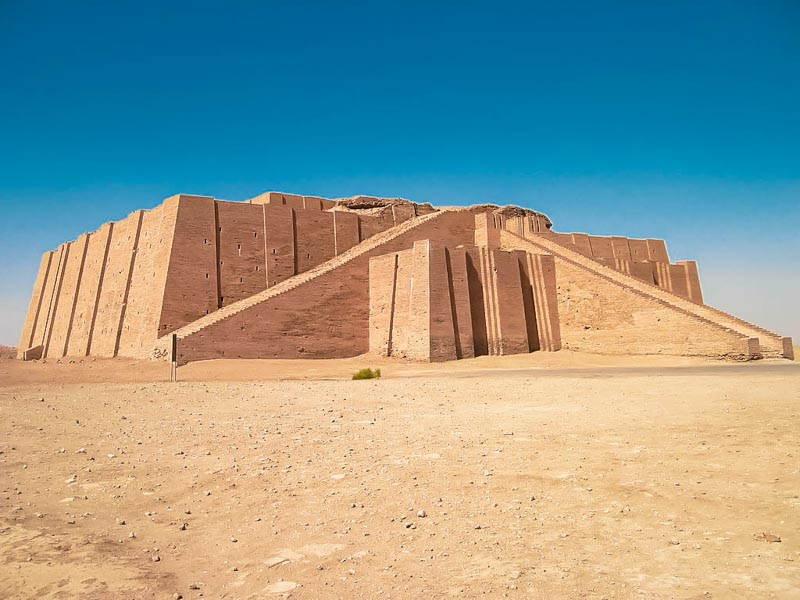
The Ziggurat of Ur — a stepped temple structure that dominated the Sumerian cityscape.
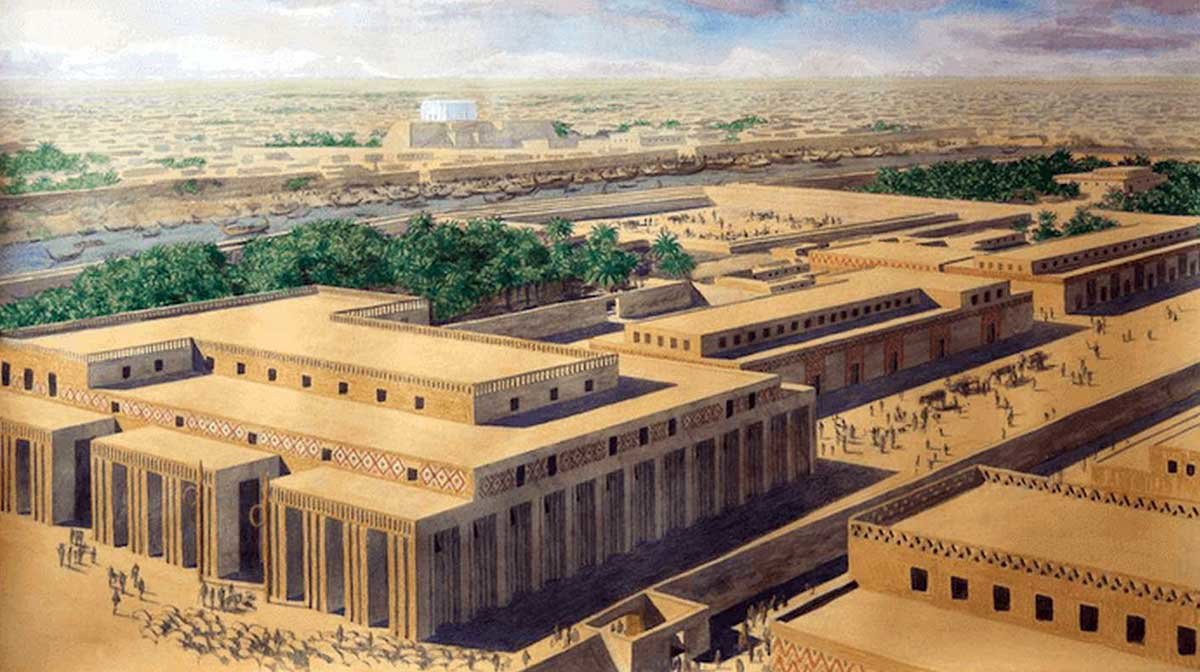
Artistic reconstruction of Uruk, considered the world's first true city.
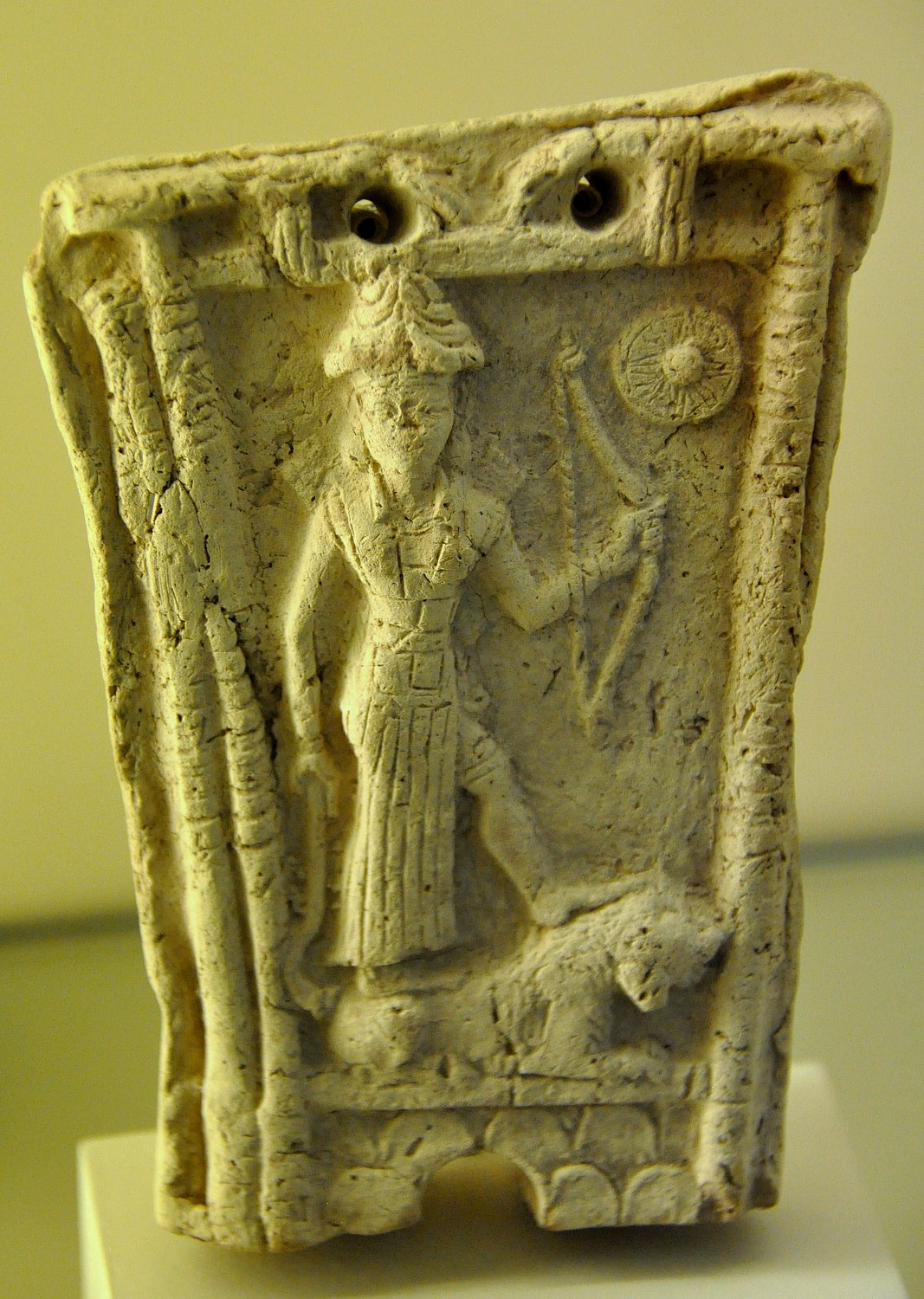
Ancient terracotta relief of the goddess Inanna/Ishtar.
Artistic visualization of ancient Sumerian civilization.
The Isonzo Region
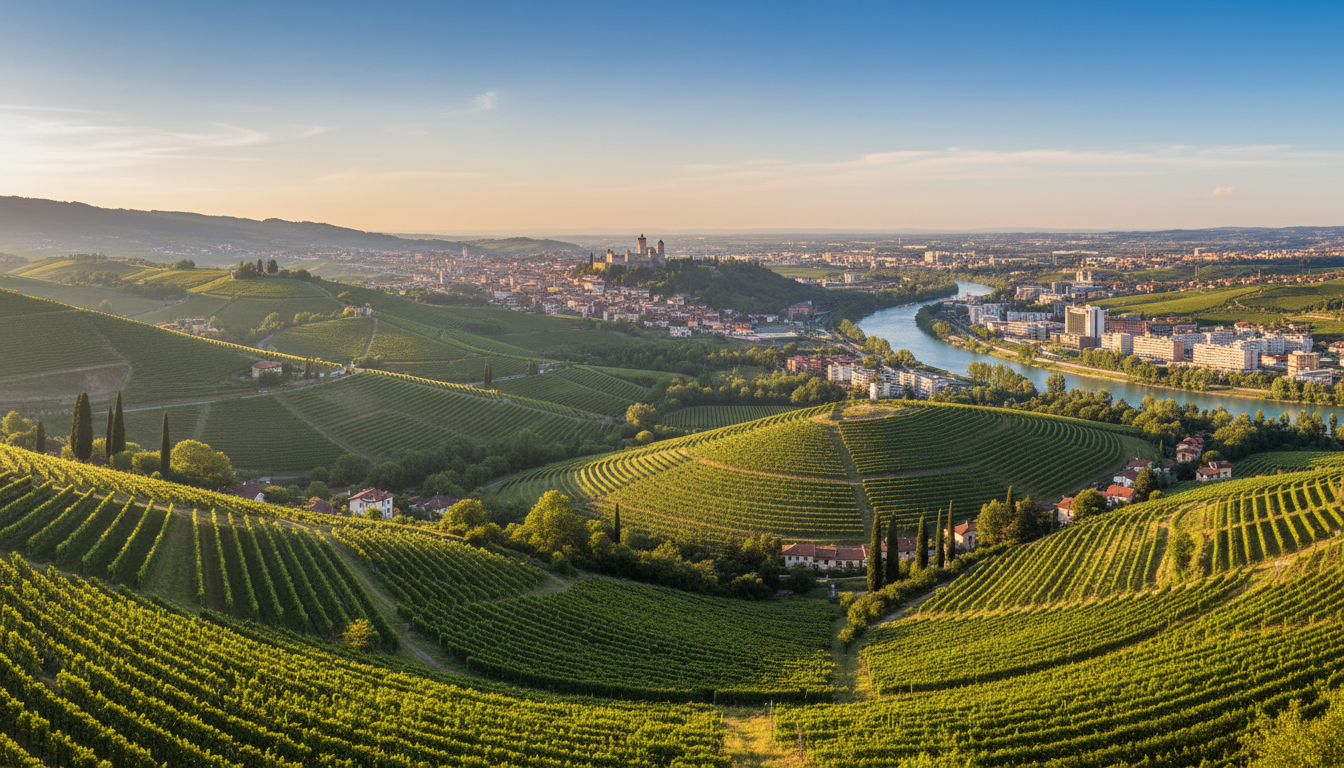
The Isonzo (Soča) Valley has been a crossroads of civilizations for millennia. The Sumerian exhibition at Hotel Major brings the theme of ancient civilization to a region that has itself been shaped by the flow of peoples, armies, traders, and artists across its landscapes. The Isonzo River — known as the Soča in Slovenian — has witnessed Roman legions, medieval merchants, Habsburg administrators, World War I soldiers, and now, the peaceful flow of European citizens across a border that no longer divides.
The region's layered history — from the Roman city of Aquileia to Habsburg-era Gorizia, from the Italian-Slovenian border conflicts to today's GO! Borderless cooperation — provides a fitting backdrop for an exhibition that reaches back 5,000 years to the dawn of civilization.
Everything You Need to Know
Dates
May 16, 2025 — December 31, 2026
Permanent exhibition
Opening Hours
During hotel opening hours
Hall and restaurant room
Admission
Free
Address
Hotel Major
Via Pietro Micca 19
Ronchi dei Legionari (GO), Italy
Accessibility
Step-free access
Free hotel parking
Part of
GO! 2025 European Capital of Culture
GO! Borderless
How to Get There
By Car
From Nova Gorica, take the A34 towards Gorizia and continue on the A4 motorway. Exit at Redipuglia/Monfalcone West; Hotel Major is 800 metres from the exit. The journey takes approximately 20–25 minutes.
By Train + Taxi
Regional trains connect Nova Gorica/Gorizia with Monfalcone. From Monfalcone station, Hotel Major in Ronchi dei Legionari is about 8 km away — a short taxi or bus ride.
By Bus
Regional bus services link Gorizia, Nova Gorica, Monfalcone, and Ronchi dei Legionari. Check local TPL FVG schedules for the most convenient connection.
Cross-Border Cultural Programme
The exhibition is part of the GO! 2025 European Capital of Culture programme. Combined itineraries and shuttle services may be available — check the official GO! 2025 website for updates.
Exhibition Themes and Experience
Visual Layer
The terracotta tablets with their earthy, tactile surfaces immediately evoke the ancient Near East. The 23-karat gold leaf applications catch the ambient light, creating a living, breathing quality — the artworks literally shimmer and change as viewers move.
Literary Layer
Pierpaolo Freschi's verses, inscribed in cuneiform and displayed alongside the paintings, invite contemplation. The poetry explores themes of time, eternity, human existence, memory, and the persistence of culture.
Historical Layer
The Sumerian deities — Inanna, Ishtar, An, Enki, Lugal — are not merely mythological figures but represent fundamental aspects of human civilization: love and war, cosmic order, wisdom and creation, and governance.
Cultural Layer
As part of GO! 2025, the exhibition participates in a larger European conversation about borders, identities, and shared heritage. The Sumerians, who created the first cities and the first writing system in a land between two rivers, offer a powerful metaphor for the borderless Europe that GO! 2025 envisions.
Six Reasons Not to Miss This Exhibition
1. A Unique Artistic Fusion
PittaPoesia literally merges painting and poetry into a single artistic language. See how Giorgio Bottò's visual works and Pierpaolo Freschi's verses create a dialogue across media.
2. Journey to the Dawn of Civilization
Explore the world's first writing system, cuneiform, and the myths of Inanna, Enki, and Lugal — brought to life through contemporary art and 23-karat gold leaf.
3. Free, Accessible Cultural Destination
Admission is free, parking is free, and the exhibition is step-free. An ideal stop for travellers arriving at Trieste Airport or exploring the Gorizia province.
4. Part of GO! 2025
Experience the cross-border spirit of the European Capital of Culture, where Nova Gorica and Gorizia unite under the theme GO! Borderless.
5. A Living Venue
Hotel Major transforms its hall and restaurant into a gallery, letting visitors encounter ancient Sumerian art in a warm, welcoming setting.
6. Perfect for a Day Trip
Just minutes from Trieste Airport and a short drive from Nova Gorica, Gorizia, and Monfalcone, the venue fits easily into a cultural itinerary.
Exhibition Photo Gallery
Official GO! 2025 exhibition poster for PittaPoesia — Omaggio agli Antichi Sumeri
Flyer for the OltreFrontiera book presentation at Hotel Major
Giorgio Bottò's terracotta tablet artwork with cuneiform and gold leaf
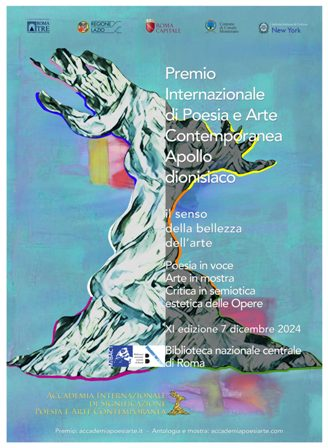
Bottò's Special Merit Recognition at the Apollo Dionisiaco Prize in Rome
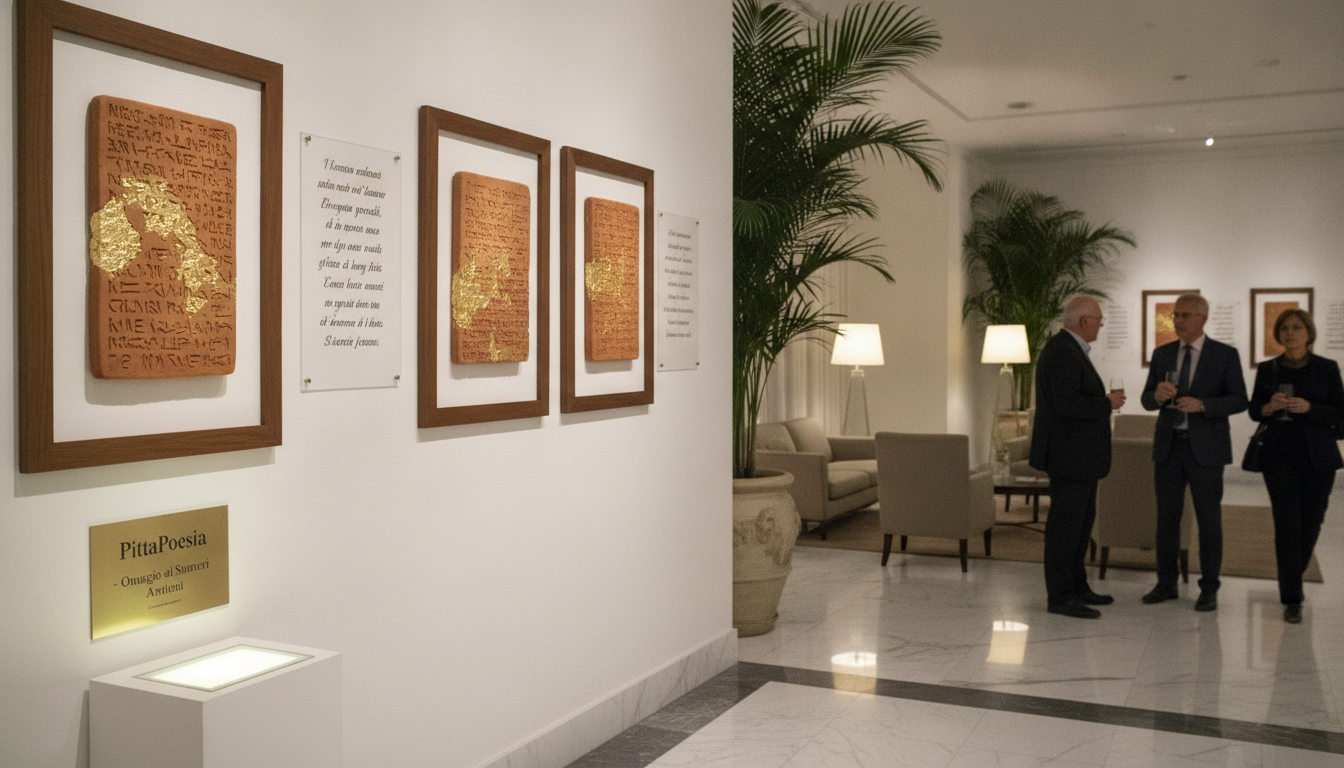
The PittaPoesia exhibition at Hotel Major featuring terracotta artworks with poetry
Close-up visualization of terracotta, cuneiform, gold leaf, and poetry
Hotel Major in Ronchi dei Legionari — venue for the permanent exhibition
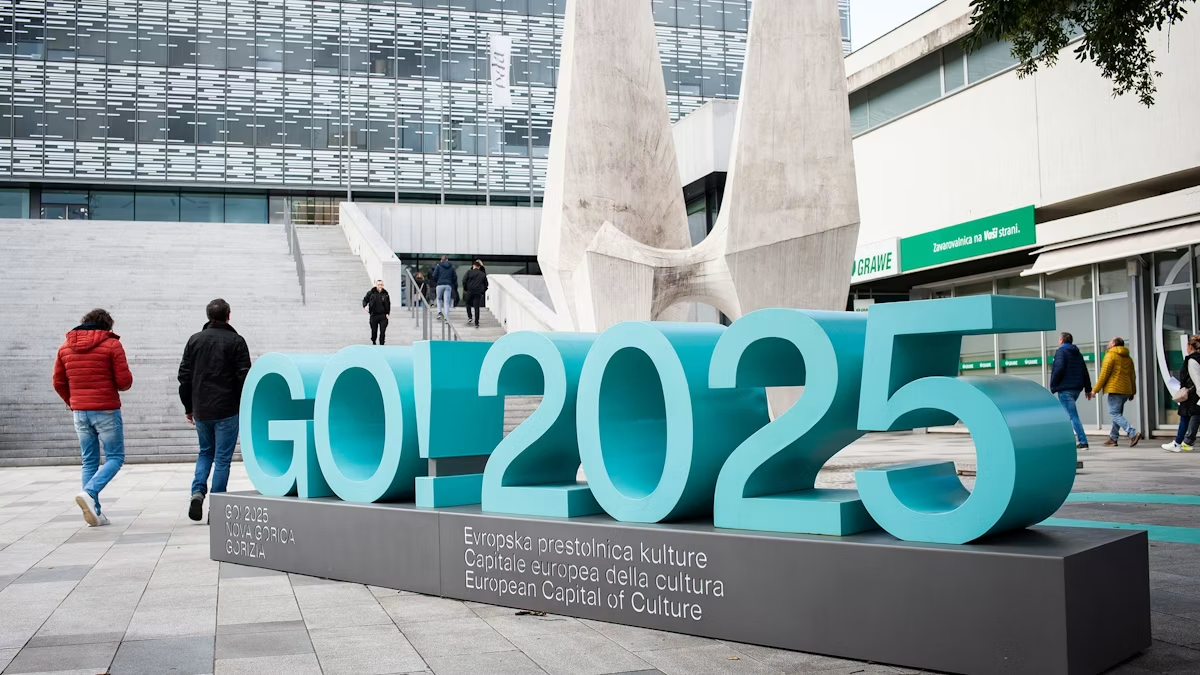
The GO! 2025 installation in Nova Gorica-Gorizia
Ancient Sumerian cuneiform clay tablet with wedge-shaped writing
Detailed view of cuneiform — the world's first writing system
The Ziggurat of Ur — a stepped temple dominating the Sumerian cityscape
Artistic reconstruction of Uruk, considered the world's first true city
Ancient terracotta relief of the goddess Inanna/Ishtar
Artistic visualization of ancient Sumerian civilization
The Isonzo/Soča Valley where Italian and Slovenian cultures meet